A PDF book from Jazz Piano Master
The Ultimate Jazz Piano Voicings and Chord Atlas
700+ voicings, from shells to advanced, in all 12 keys
From shells to advanced voicings
- Advanced Voicings
- Chord Dictionary
- Arpeggios and Lines
- Theory and History
- 30-Day Plan
- All 12 Keys
The problems
What gets in the way, and where this book answers it
People learning jazz piano name the same problems again and again in public forums. Here are seven of them, each beside the pages of the book that answer it.
The books and lessons are dense, and they are not a method you can follow in order.
Part Three
A practice book in a fixed order, one key and one voicing at a time.
The Atlaspage 55How the ladder workspage 56
Nobody tells you what to practice first.
Part Five
A 30-day plan that names what to play each day, then a 12-week schedule.
The 30-day planpage 225The 12-week schedulepage 226
You know the chords, but the voicings overwhelm you and will not come to your hands.
Part Three
Seven voicings for every chord of the ii-V-I, from shells to quartal and upper-structure color.
The key of C, Level 1page 59
The voicings you learn will not come back when you need them, in another key or in the middle of a tune.
Part Five
Every level printed in all 12 keys, with a tracker to tick key by key.
Your ladder in twelve keyspage 227
Nobody explains why any of it works.
Part Two
The foundations in plain words, then the 20 Rules of voicing.
The Foundationspage 33The 20 Rulespage 48
Your solos sound like random notes from a scale.
Part Four
The Line Method: four patterns that turn the chords into melody.
The Line Methodpage 157The four patternspage 170
There is never enough time to practice.
Part Five
Fifteen minutes a day: three on a voicing you own, eight on the day's level, four on lines.
The fifteen-minute routinepage 224
Inside
A practice book first, with all the theory you need explained in plain words.
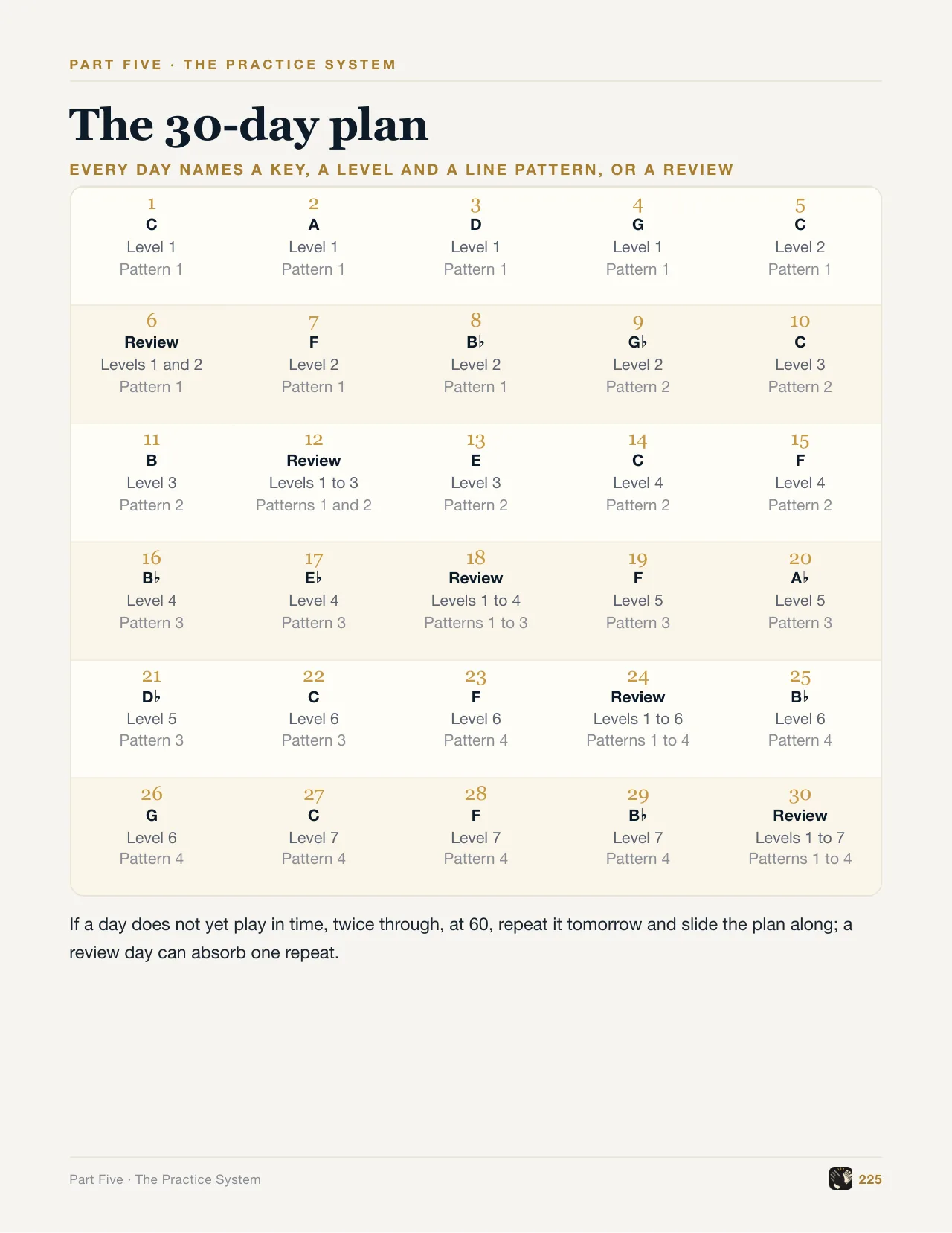
Seven levels of voicings over the major and minor ii-V-I, one key at a time, in all 12 keys. Every day names a key, a level and a line pattern, or a review.
700+ different voicings in all 12 keys
Chords of up to 8 notes, in both hands
- 7 levels of voicings for every ii‑V‑I chord, from shells to quartal and upper-structure color
- 21 chord types in all 12 keys, each with its notes by degree and one two-hand voicing
- 100+ lines and arpeggios, in both hands
- A 30-day plan and a 12-week schedule, 15 minutes a day
- A blues page in every key
- A PDF you download and keep, no subscription
- Every voicing shows which hand plays which notes, and every line is fingered.
- Every voicing checked by software, note by note, before it was printed.
- Theory and history, explained in plain words.
10 pages from the book. Tap a page to read it large.
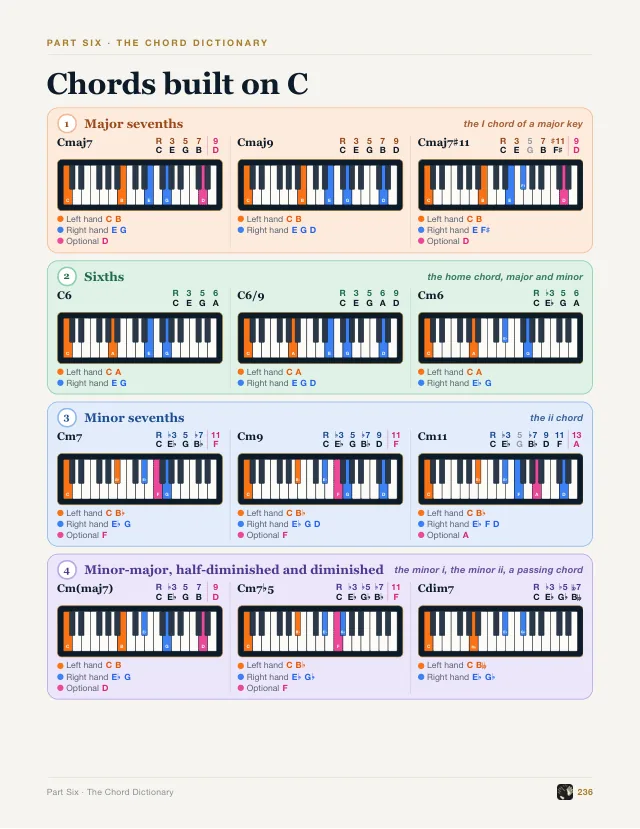
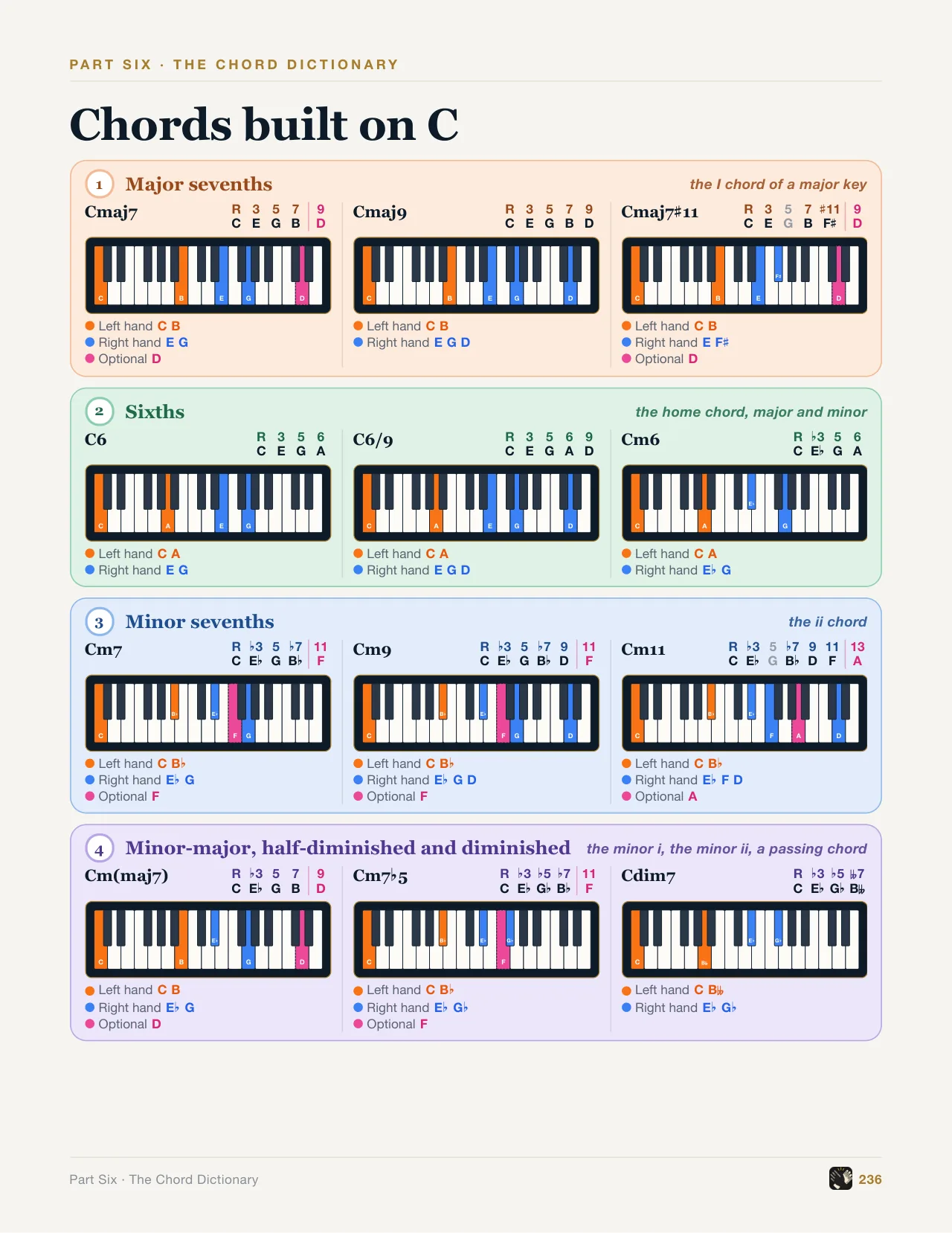
Page 236Part Six, the chord dictionary: every chord type on its own keyboard, spelled by degree. 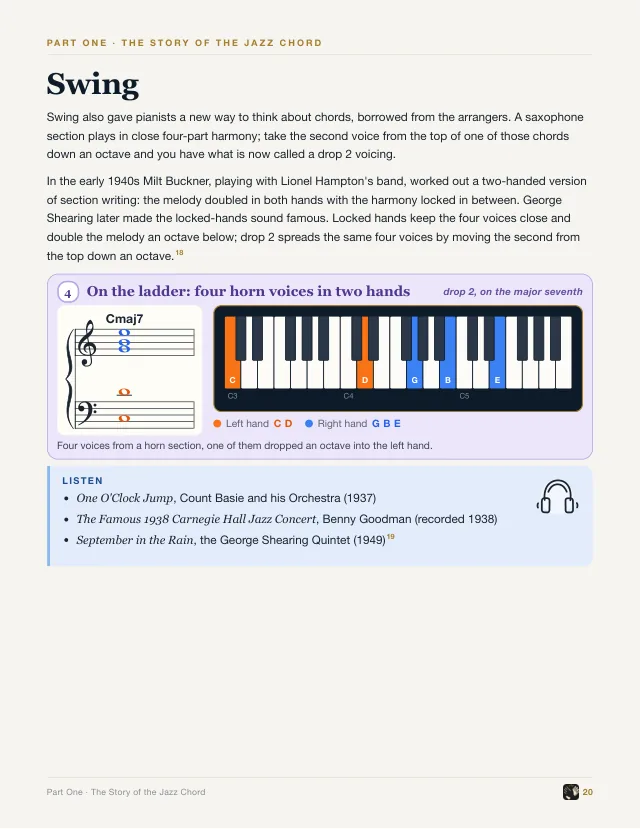
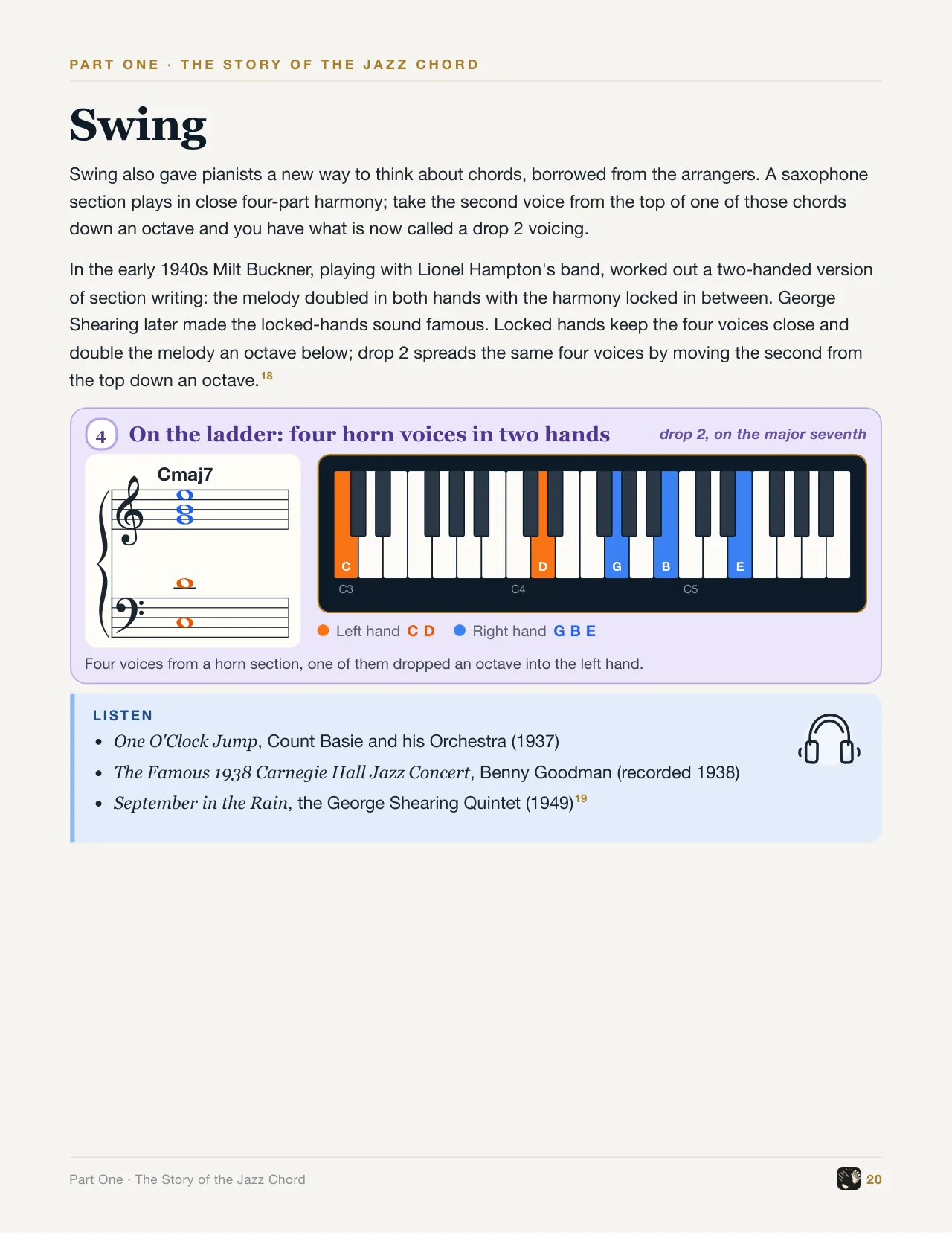
Page 20Part One, the story of the jazz chord: each era with the voicing it gave the piano. 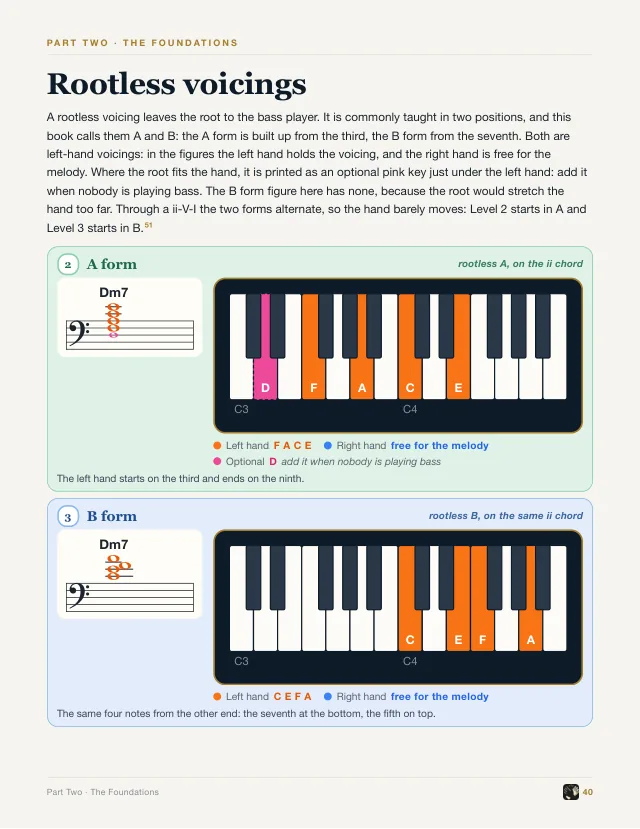
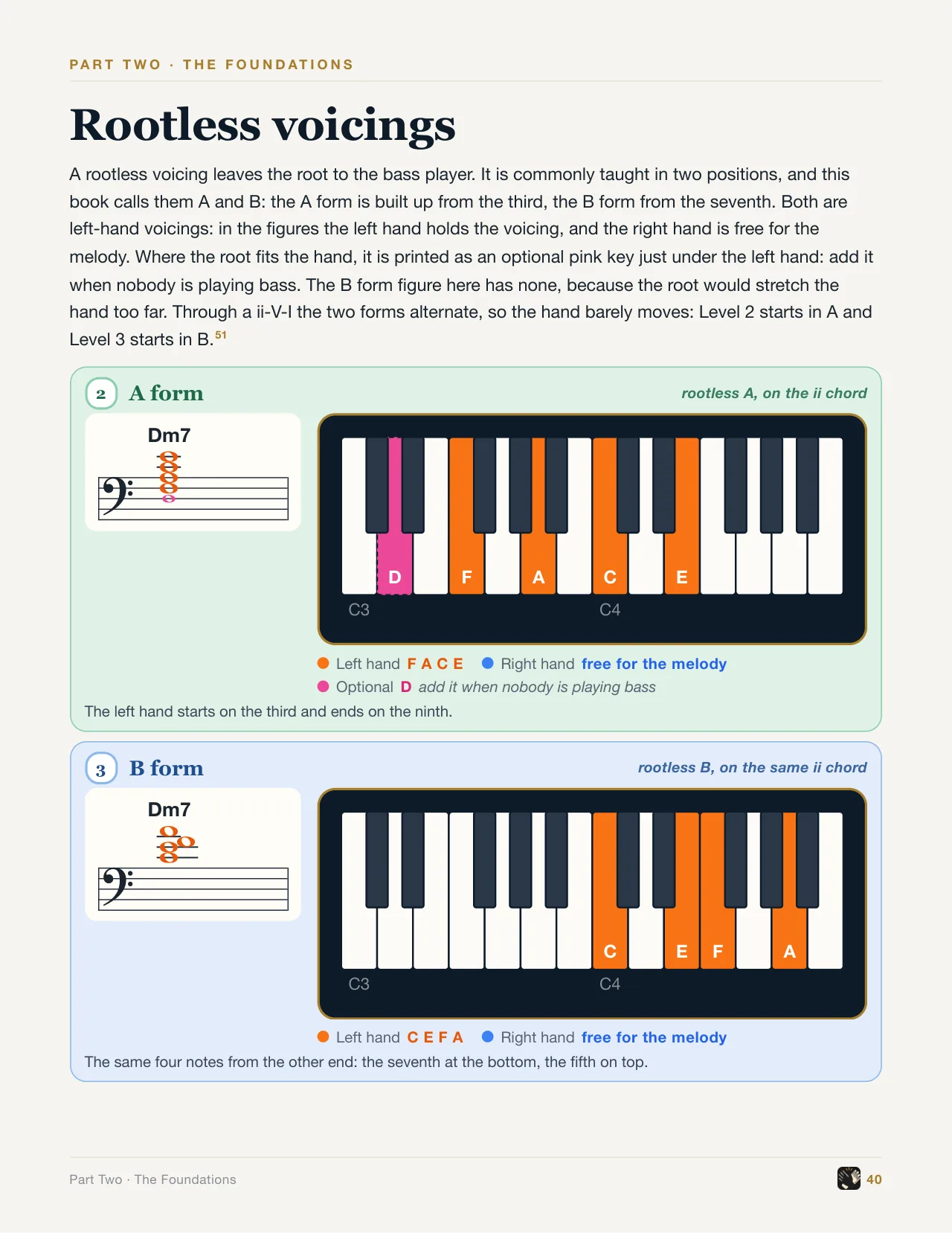
Page 40Part Two: the two rootless shapes, A and B, with the root in pink where you can add it. 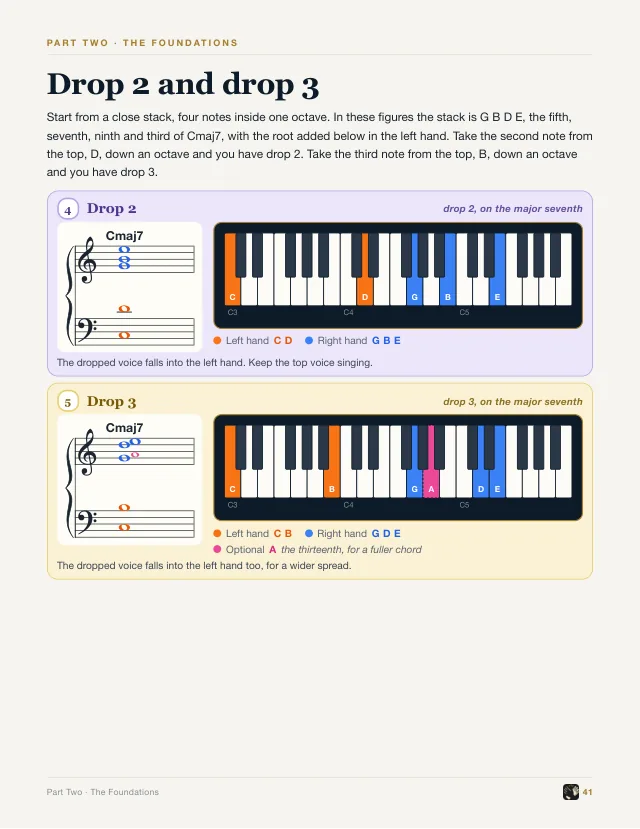
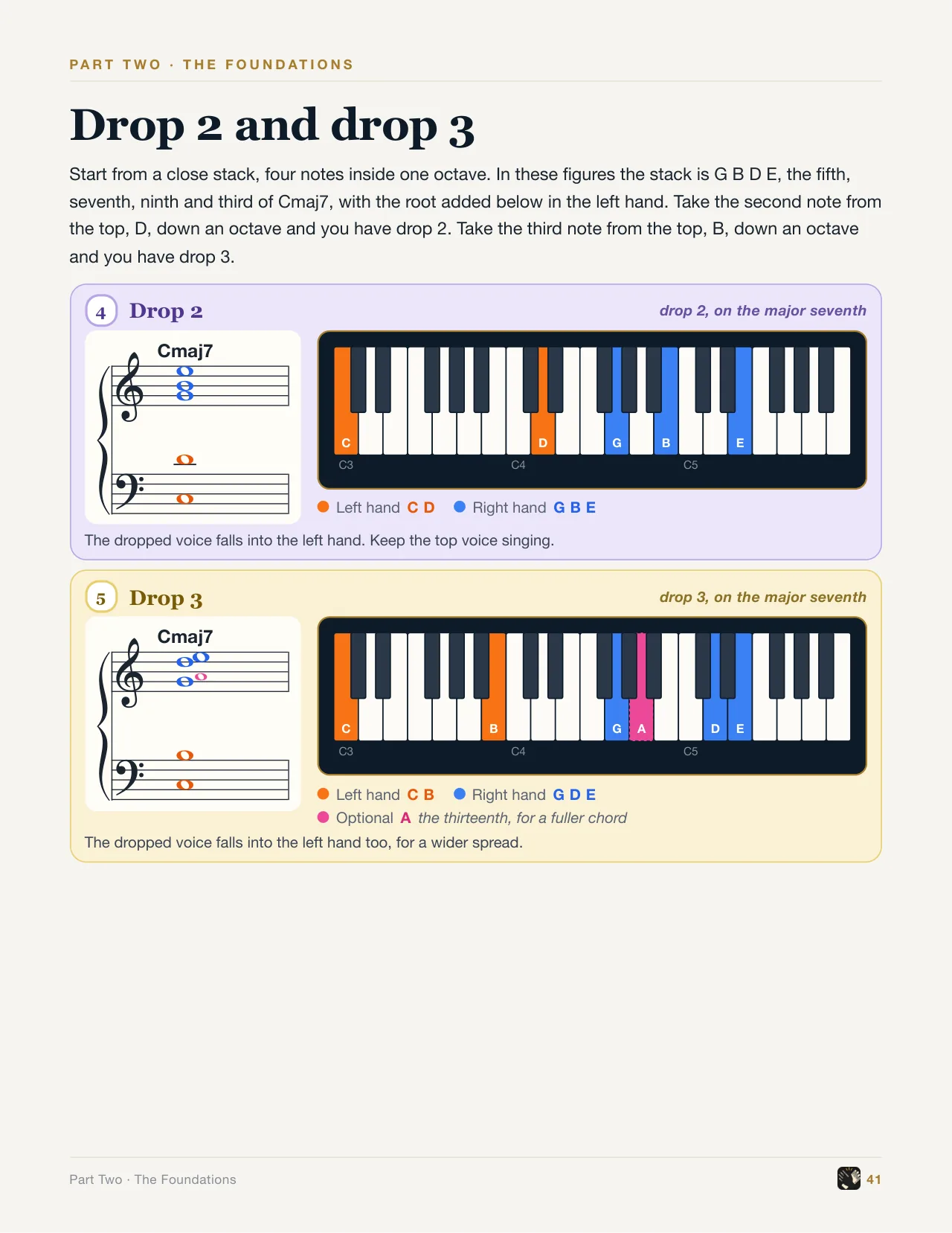
Page 41Part Two: drop 2 and drop 3, the voicings that spread a chord across both hands. 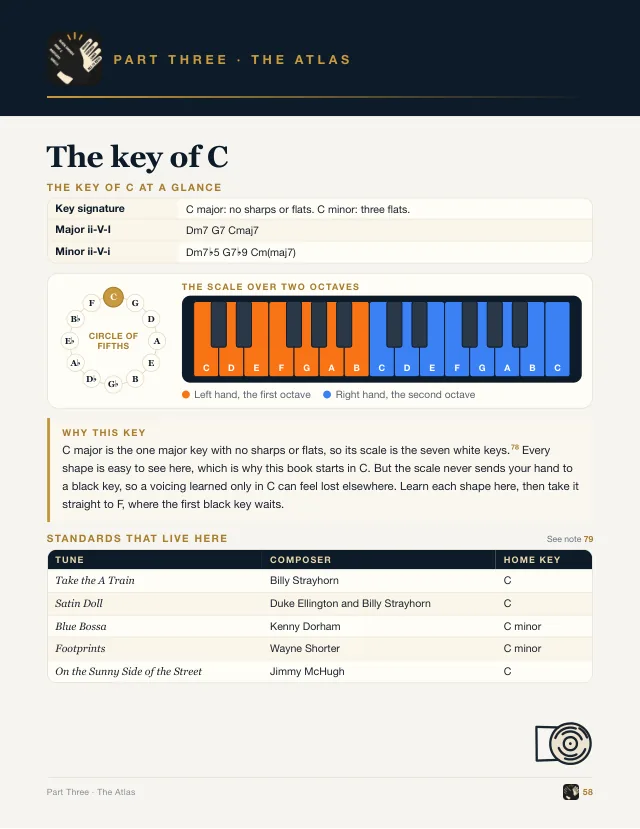
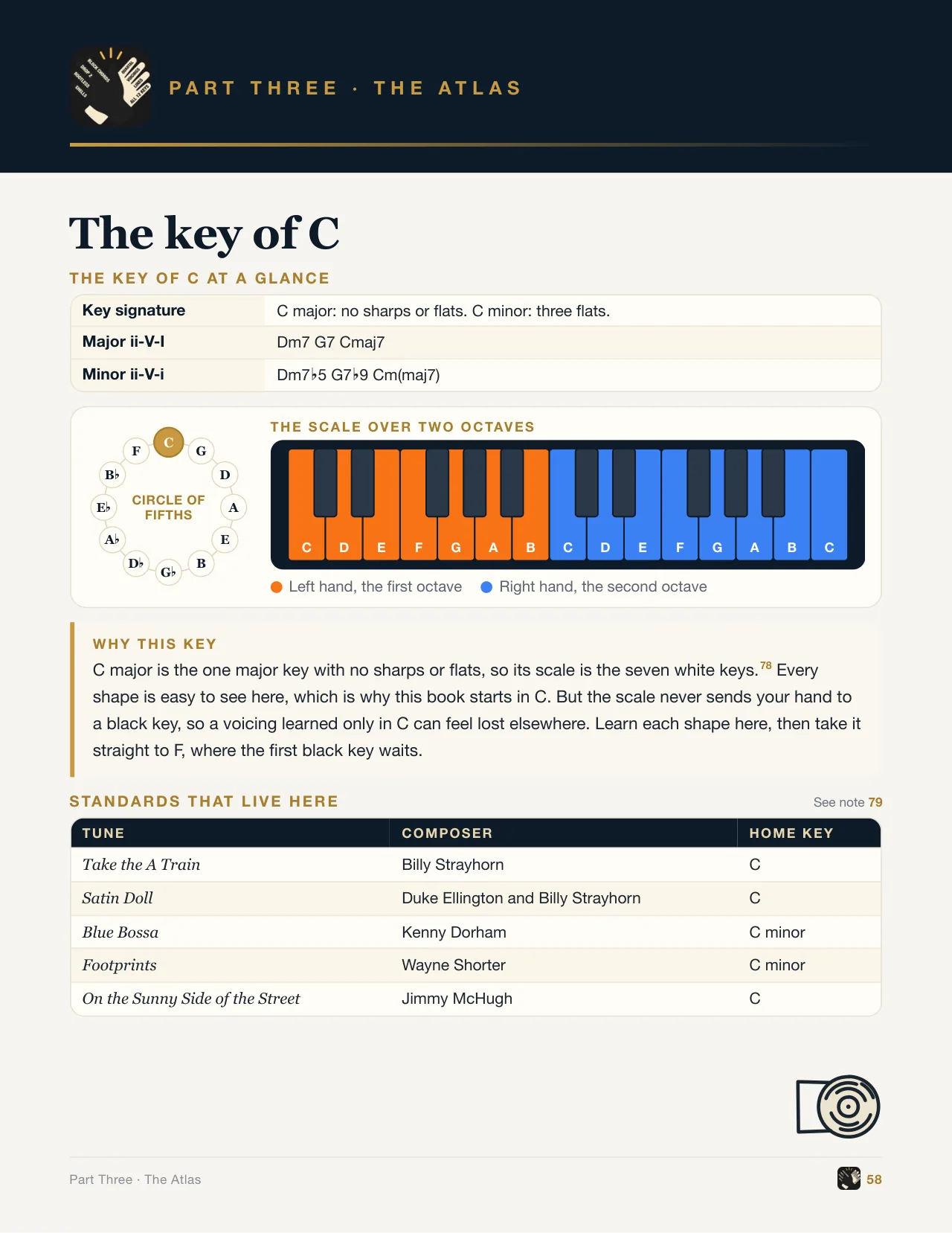
Page 58Every key opens with its portrait: its place on the circle, its scale and the standards played in it. 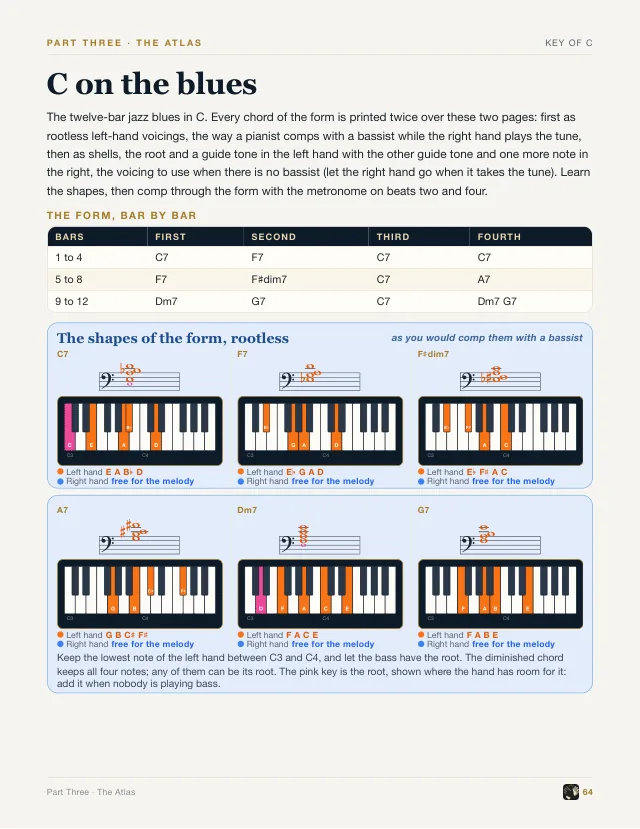
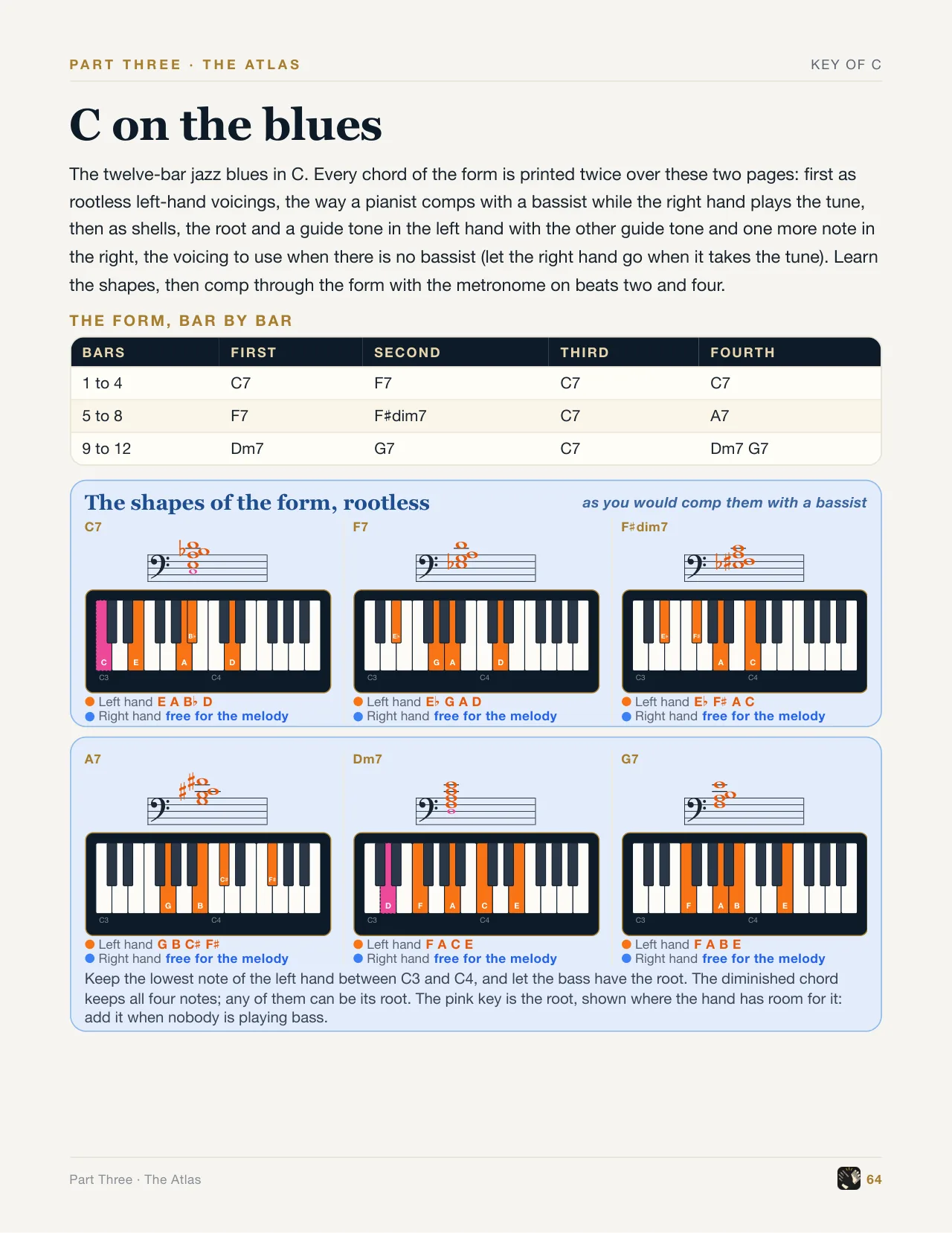
Page 64The twelve-bar blues in C, with a shape for every chord of the form. 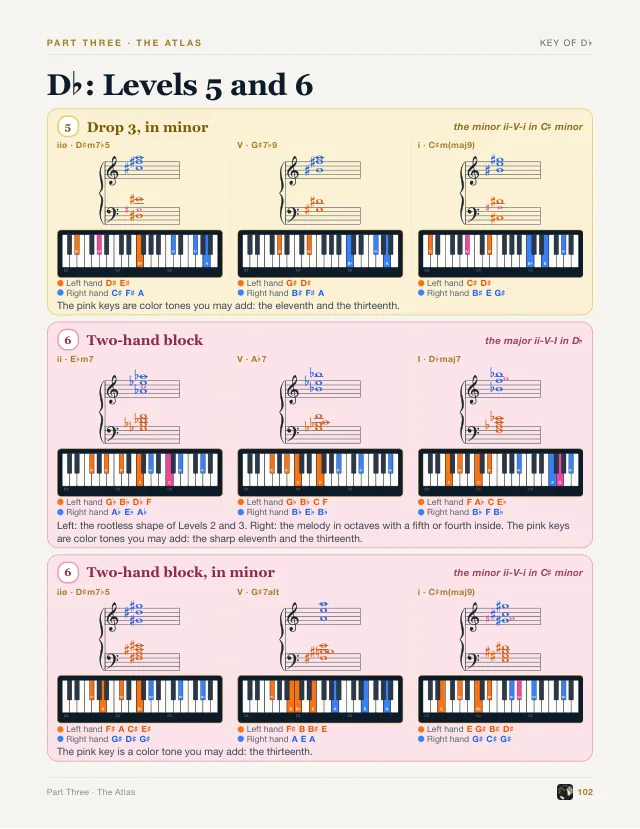
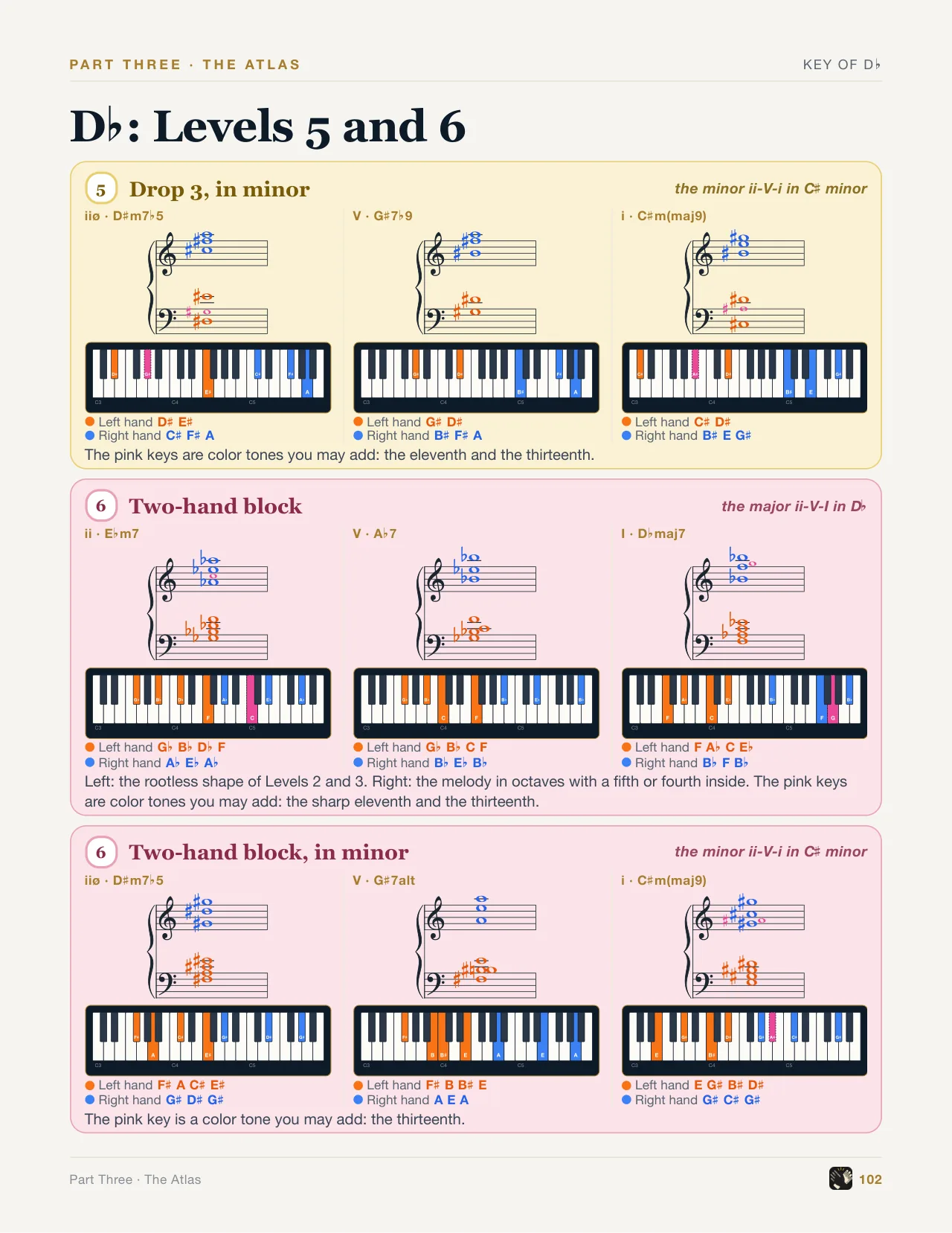
Page 102The ladder climbs in every key. Here, D flat at Levels 5 and 6, in major and minor. 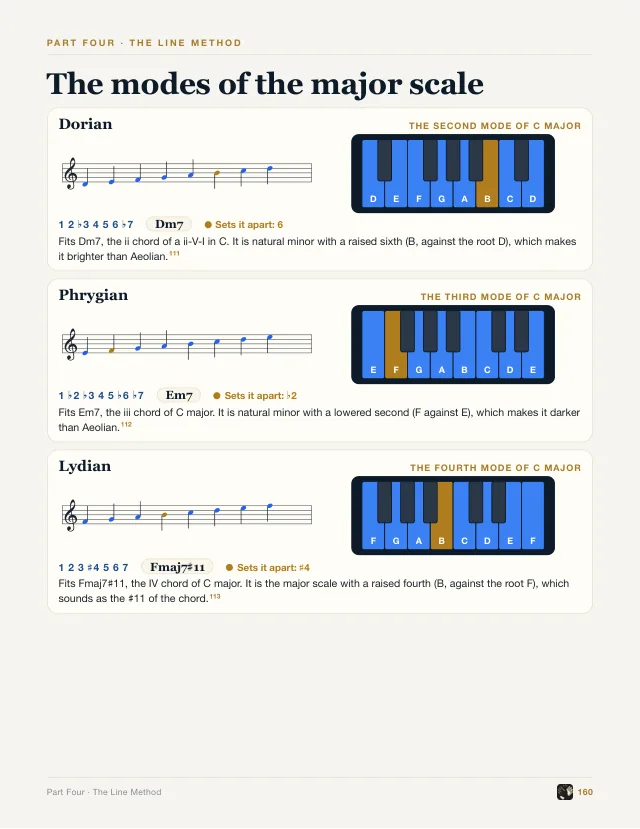
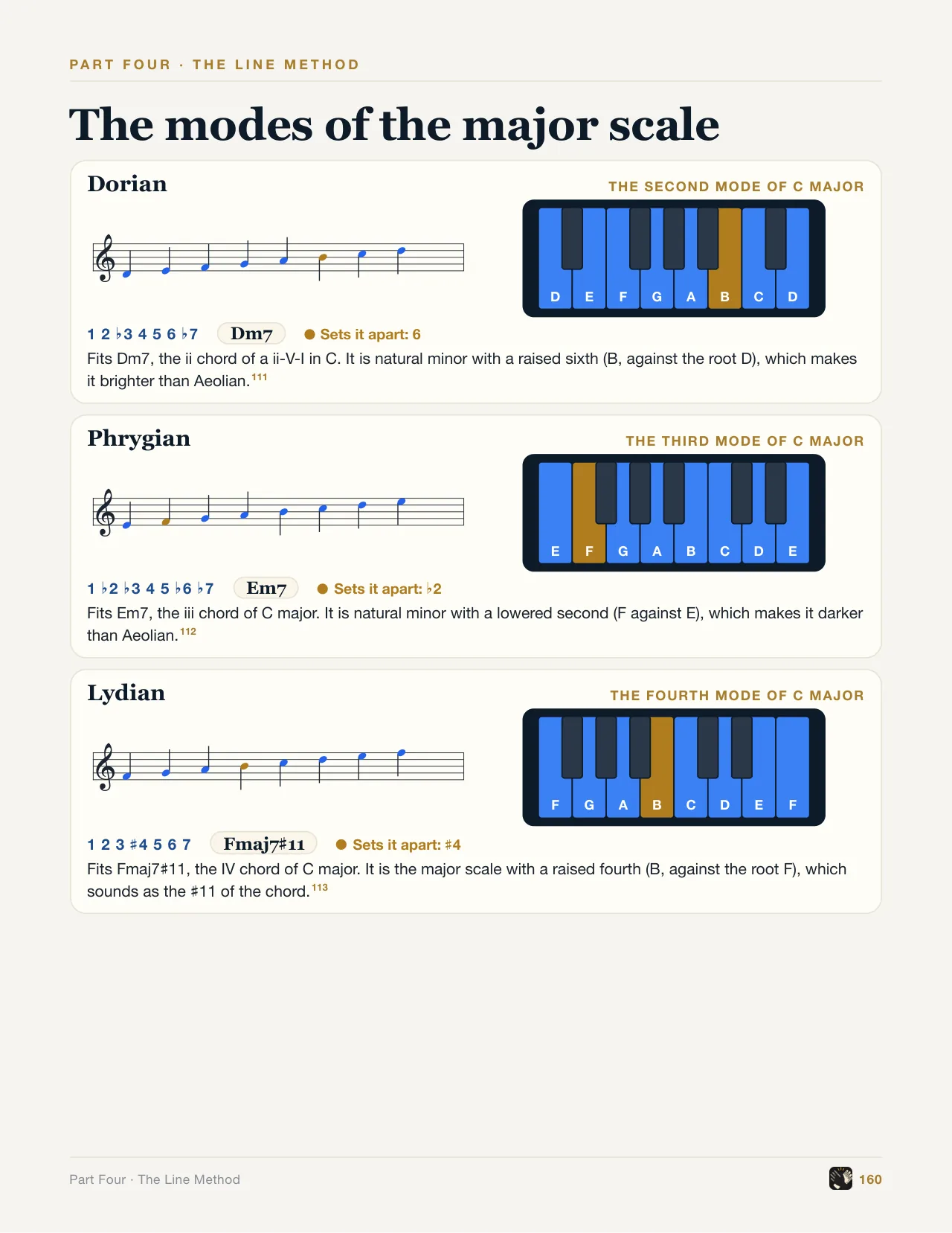
Page 160Part Four: the scales on a staff and a keyboard, each with the note that sets it apart. 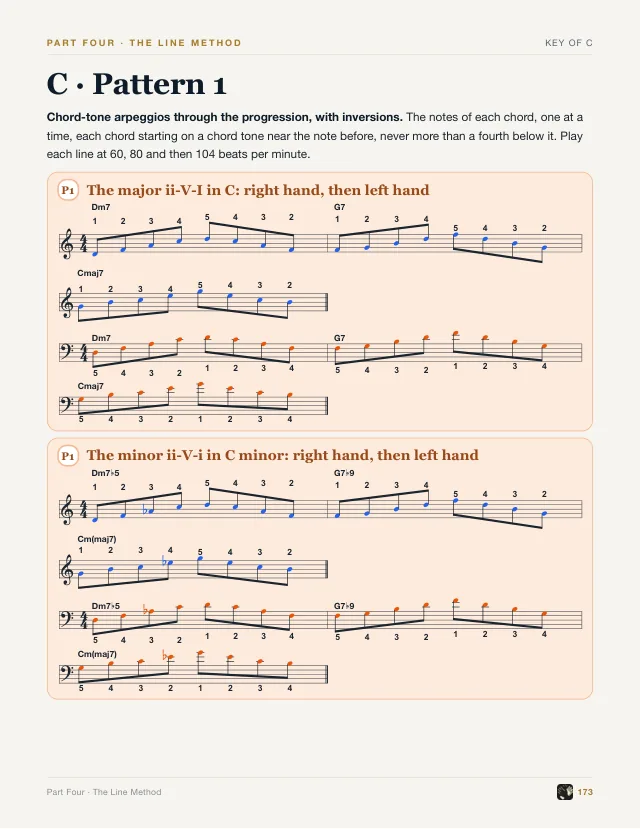
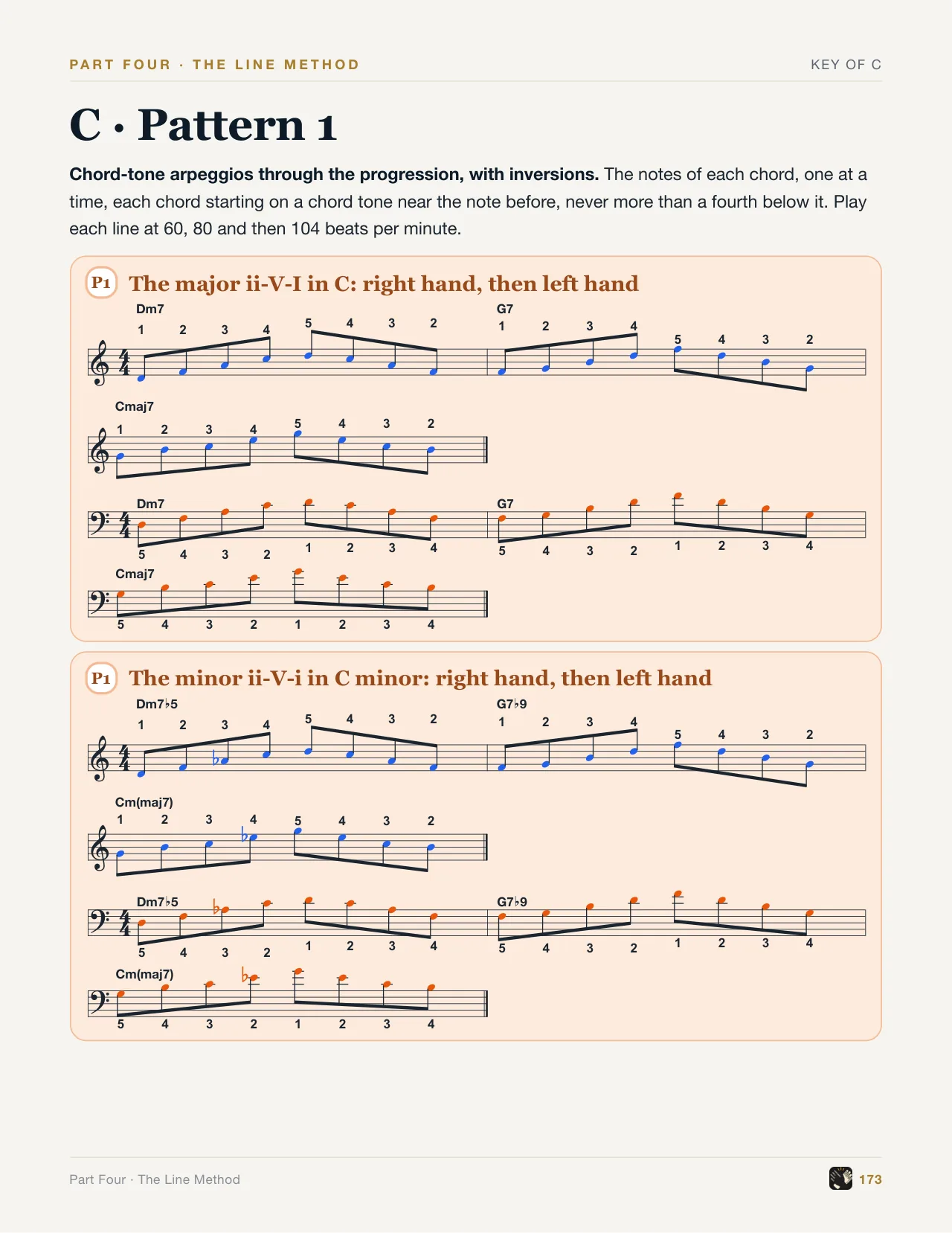
Page 173Part Four, the Line Method: a line for each hand through the ii-V-I, fingered note by note. 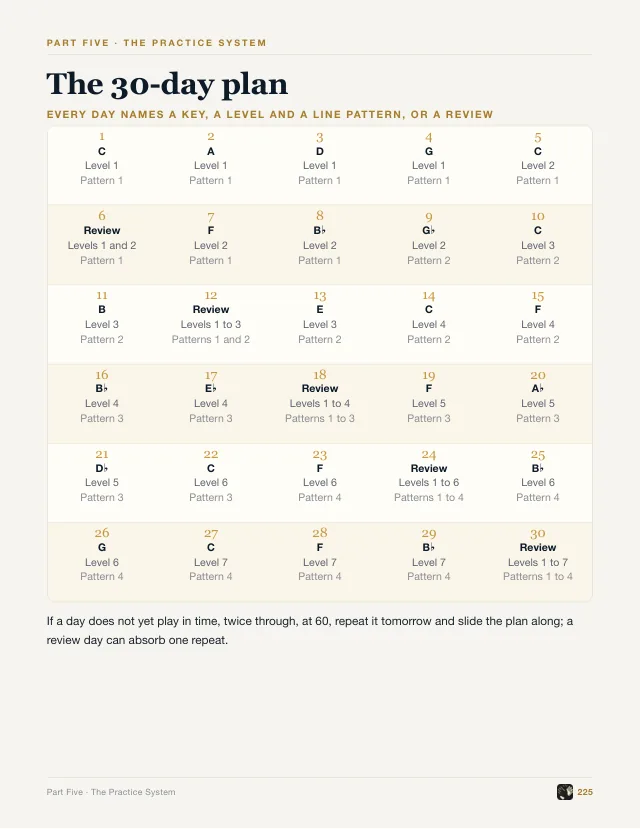
Page 225The 30-day plan. Every day names a key, a level and a line pattern, or a review.
Hear it
One ladder in C, seven levels
The major ii-V-I in C on every level of the ladder, on the keyboards the book prints: the left hand in orange, the right hand in blue, the optional notes in pink. Tap Play to hear a level, or a keyboard to hear one chord.
Two‑hand shells
Page 59
iiDm7
RHFE
LHDC
VG7
RHFE
LHGB
ICmaj7
RHED
LHCB
Rootless A
Page 59
iiDm7
RHfree for the melody
LHDFACE
VG7
RHfree for the melody
LHFABE
ICmaj7
RHfree for the melody
LHCEGBD
Rootless B
Page 60
iiDm7
RHfree for the melody
LHCEFA
VG7
RHfree for the melody
LHGBEFA
ICmaj7
RHfree for the melody
LHBDEG
Drop 2
Page 61
iiDm7
RHACF
LHDE
VG7
RHABF
LHGD
ICmaj7
RHGBE
LHCD
Drop 3
Page 61
iiDm7
RHFGCE
LHDA
VG7
RHADF
LHGB
ICmaj7
RHGADE
LHCB
Two‑hand block
Page 62
iiDm7
RHGBDG
LHFACE
VG7
RHADA
LHFABE
ICmaj7
RHAEF♯A
LHEGBD
Quartal and upper‑structure color
Page 63
iiDm7
RHABEA
LHDGCF
VG13♯11
RHAC♯EA
LHGBF
ICmaj7♯11
RHADF♯A
LHCGBE
Right handLeft handOptionalThe book prints each voicing on a staff and a keyboard in the same colors, the optional notes small and pink.
The app
Get the app
Jazz Piano Master is our app for learning jazz piano, free to download with in-app purchases.


The price
$27, once.
A PDF you download and keep. No subscription.
Buy the AtlasOne-time purchase of a digital download, so all sales are final and we do not offer refunds, except where the law requires one. Questions before you buy? Write to support@jazzpianomaster.com.
Questions
Before you buy
- Who is the Atlas for?
- Pianists who know their chords and want them to sound like jazz: players who can read a chord symbol such as Dm7 or G7 and want voicings that come back to their hands in every key.
- What level do I need?
- If you can play a major scale and read a chord symbol such as Dm7, you can start. Part Two builds everything else from the intervals up, and every voicing is printed on a keyboard and a staff with the notes of each hand named.
- What do I get, and where can I read it?
- One PDF of the whole book, yours to keep. It opens on iPhone, iPad, Android, Mac and PC, and it prints on US Letter paper. There is nothing to install and no account to make.
- How does the app fit in?
- The book stands on its own. Jazz Piano Master is a separate app for learning jazz piano, free to download with in-app purchases. Every key in the book carries a QR code to get the app.
- How long does it take each day?
- Fifteen minutes a day, in three steps: three minutes on a voicing you already own, eight on the level of the day, four on lines. The 30-day plan names a key, a level and a line pattern for each day, or a review every sixth day, and the 12-week schedule gives each week a level, a line pattern and three keys.
- Can I get a refund?
- No. The Atlas is a one-time purchase of a digital download that is yours the moment you pay, so all sales are final and we do not offer refunds, except where the law requires one. If your download does not work, write to support@jazzpianomaster.com and we will fix it.
- Lost your download link?
- Get your download link again: enter the email you used at checkout, and we send the link to that address. Nothing arrives? Write to support@jazzpianomaster.com.
15 minutes a day, in every key
Open it at the piano tonight and start with Level 1 in C.
Get the Atlas, $27