Writing
Jazz Piano Blog: Voicings, Harmony, History
Pieces that go all the way to the keyboard. Every claim about what a pianist played is traceable to the app's own data or to a cited source, and every chord is printed as notes rather than described.
apps · learning · practice
Best Jazz Piano Apps in 2026, Compared
Most roundups of piano apps barely mention jazz. This one compares the apps that teach or support jazz piano, plus the two general apps people ask about: what each one teaches, which stores carry it, whether it can hear you play, and the job each does better than the rest, including the jobs where a rival beats the app we make.
books · learning · voicings
Best Jazz Piano Books, by What They Teach
Most lists of the best jazz piano books sort them by level. Once you can read a chord symbol, the better question is which skill is missing from your playing. Here are twelve books sorted by what each one teaches and what each one expects of you on the first page, with the one we wrote marked as ours.
learning · beginners · practice
How to Learn Jazz Piano: A Step by Step Path
Most people who stall at jazz piano have plenty of material and no order to take it in. This is one order: ten steps that run from daily listening and your first seventh chords to a first jam and on into your second year, each with an honest rough time, and with the places marked where a teacher and other musicians do what no page can.
listening · history · discography
50 Essential Jazz Albums, Years Checked
50 essential jazz albums, and their real years. The records on a list like this are never the argument. The years beside them are, and they are wrong more often than anyone admits: session dates printed as release dates, catalogue columns printed as street dates, reissues read as originals. Here are fifty, with every year traced to two independent sources before the page was allowed to build, and the disagreements printed rather than quietly resolved.
voicings · arranging · block-chords
Drop 2 Voicings on Piano, Explained
Drop 2: the voicing borrowed from the horns. One note moves an octave and a closed chord becomes a two-handed one. What makes drop 2 worth learning is not the wider sound, it is that the melody note never moves. That is why it came from arrangers writing for four horns, and why it still behaves like four horns under your hands.
chords · repertoire · beginners
The 10 Most Common Jazz Chords, Counted
The ten chords you actually need, counted. Every list of first chords for jazz piano is somebody's opinion about what matters. This one is a count. We took the chord symbols out of the app's whole book of standards, sorted them by how often they occur, and the answer turns out to be both smaller and stranger than the usual advice.
voicings · monk · harmony
Thelonious Monk Voicings: One Shape
Monk's chords are one shape and a decision. Three notes, a half step at the bottom and a third on top, small enough to sit inside a perfect fourth. That one hand position covers the major sevenths, the whole of the major scale, the melodic minor and the altered dominants. The half step it is built on is the interval everyone else spends their time avoiding.
voicings · quartal · modal
Quartal Voicings and the So What Chord
The So What chord answers to three names. Five notes, three stacked fourths and a major third on top. Depending on what the bass plays underneath, the same hand position is a D minor chord, a B-flat major chord or an E-flat Lydian chord. That ambiguity is not a flaw in the voicing, it is the reason pianists reach for it.
history · lineage · listening
Jazz Piano Family Tree: Who Influenced Whom
The family tree is an argument, not a record. Every diagram of who influenced whom in jazz piano looks like a record of what happened. None of them is. Each arrow is somebody's judgement, each missing name is somebody's decision, and the most informative part of ours turns out to be the ten names it cites as influences and does not contain.
harmony · reharmonization · bebop
Tritone Substitution on Piano, Explained
Tritone substitution: only the bass moves. Two dominant chords a tritone apart share the same two notes, with the roles swapped. Which means the substitution most people learn as a chord change is often not a change of hand position at all. Once you see that, the reason it works and the reason it sometimes ruins a tune both become obvious.
practice · history · learning
How Great Jazz Pianists Practised
How ten jazz masters actually practised. Much of what circulates about how the great pianists practised turns out to be untraceable when you go looking. Here is what the record genuinely supports for each of the ten pianists on this site, where it says nothing at all, and what the documented cases turn out to have in common once you count them instead of asserting it.
harmony · progressions · reharmonization
The ii-V-I Progression on Jazz Piano
The ii-V-I is a question and an answer. Usually the first progression a jazz student learns, and the last one they finish with. Not because it is complicated, but because so much of what happens in tonal jazz harmony is a substitution for one of its three chords, and you cannot hear a substitution until you know what it replaced.
voicings · harmony · comping
Rootless Voicings on Piano: A and B Forms
Rootless voicings: why the root is left out. The most widely shared hand position in modern jazz piano leaves out the one note the chord is named after. Here is the shape, why the omission is the point, and what the pianists who play it reach for instead when they want to sound like themselves.
Free download
The Jazz Voicing Cheat Sheet
Shells in C, then the two rootless voicings pianists trade between, written out in all 12 keys, with a twelve-key checklist to tape to the piano. Ten pages, free.
One confirmation click, then the PDF. Unsubscribe anytime, one click, no games. See our privacy policy.
The PDF book
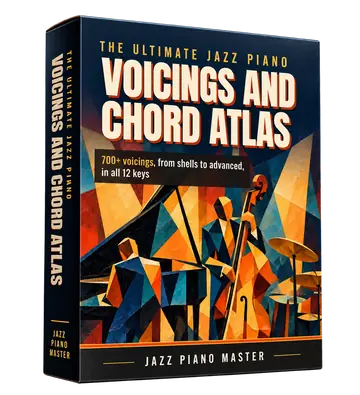
The Ultimate Jazz Piano Voicings and Chord Atlas
From shells to advanced voicings. A practice book first, with all the theory you need explained in plain words.
- 7 levels of voicings for every ii‑V‑I chord, from shells to quartal and upper-structure color
- A 30-day plan and a 12-week schedule, 15 minutes a day
- A PDF you download and keep, no subscription