Reference
Jazz progressions
A chart tells you the chords. These pages tell you where the fingers go — an octave-specific left hand and right hand, wherever the source separates them.
There are 27 progressions here and 118 hand positions between them, drawn from the harmony bible inside the app. Turnarounds and endings are written in C; each blues form sits in the key the source gives it.
None of this is a tune. These are the devices tunes are made of — the two bars that send a chorus back to the top, the cadence that stops it, the twelve bars a jam session is most likely to call. What the app adds to them, and what a chord chart never does, is the octaves: a left hand and a right hand, transcribed, drawn on a keyboard wherever the transcription separates the hands. Where it does not — a bar carrying two chords at once — the chords are printed and the page says why nothing is drawn.
Turnarounds
The last two bars, sending the form back to the top.
- Classic I-vi-ii-V
- I-VI7-ii-V (Dominant VI)
- Tadd Dameron (I-bIII7-bVI7-bII7)
- Chromatic Descending (I-biii-ii-bII7-I)
- Blues Cadence (I7-IV7-bVII7-I7)
- Rhythm Changes A (I-VI-II-V)
- Minor Turnaround (i-bVI-iim7b5-V7)
- Gospel Turnaround (I-II-V-I)
- Chromatic Dominants (I-bII7-ii-bVI7)
- Coltrane Turnaround (Giant Steps Pattern)
Endings
How the tune stops — the cadence everybody in the band is waiting for.
Blues forms
Full twelve-bar choruses, plus the intros, turnarounds and fragments that surround them.
Free download
The Jazz Voicing Cheat Sheet
Shells in C, then the two rootless voicings pianists trade between, written out in all 12 keys, with a twelve-key checklist to tape to the piano. Ten pages, free.
One confirmation click, then the PDF. Unsubscribe anytime, one click, no games. See our privacy policy.
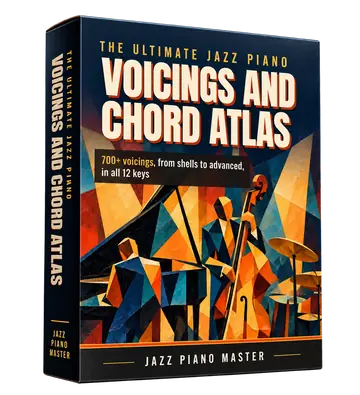
The PDF book
The Ultimate Jazz Piano Voicings and Chord Atlas
From shells to advanced voicings. A practice book first, with all the theory you need explained in plain words.
- 7 levels of voicings for every ii‑V‑I chord, from shells to quartal and upper-structure color
- A 30-day plan and a 12-week schedule, 15 minutes a day
- A PDF you download and keep, no subscription