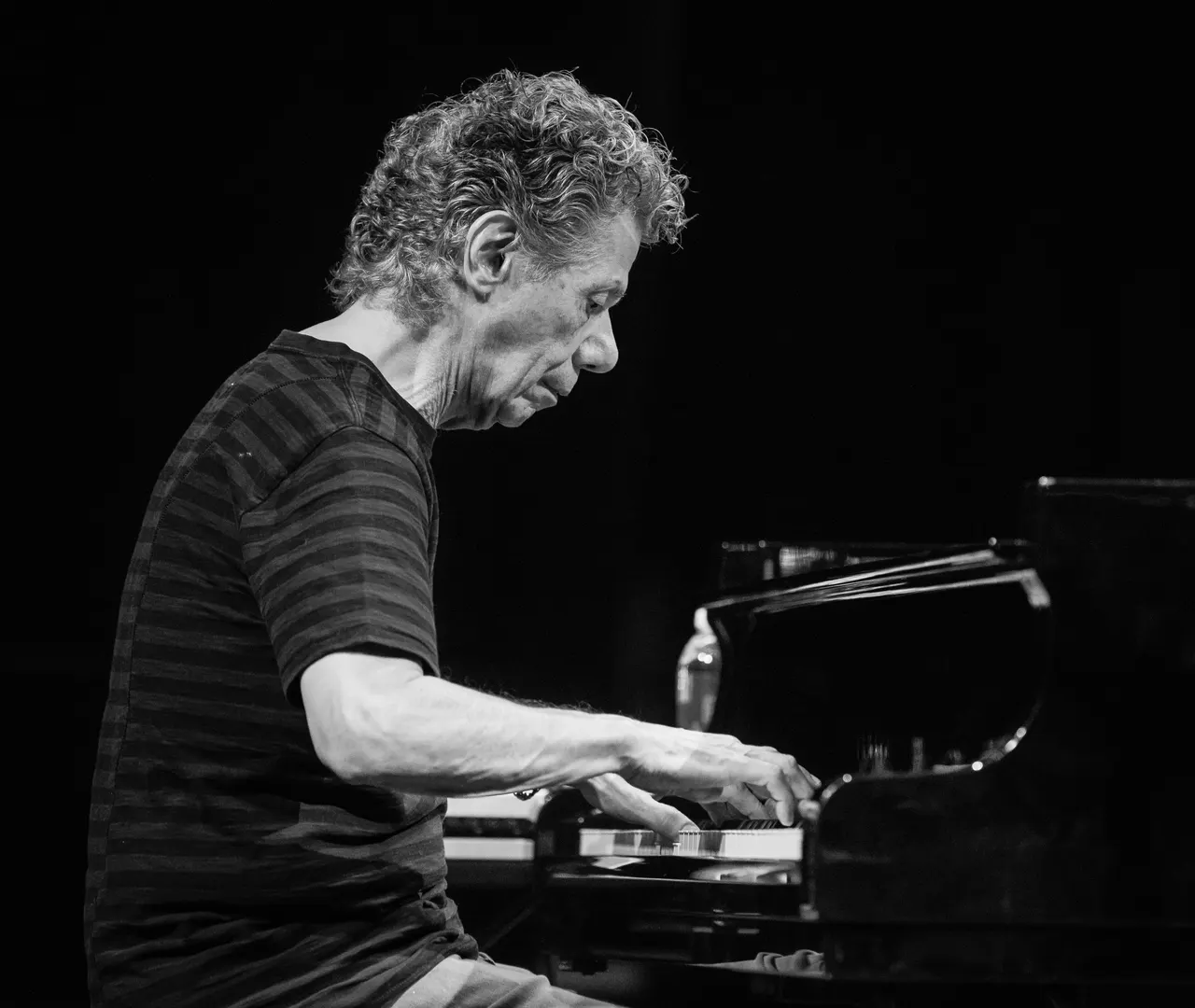
June 12, 1941 (Chelsea, Massachusetts)February 9, 2021
Chick Corea played free jazz with Anthony Braxton, electric keyboards on Bitches Brew, arena fusion with a rock light show, Mozart concertos, solo piano for ECM, duets with a vibraphonist, and a Spanish-flamenco band in his late seventies. JazzTimes had already nicknamed him the Chameleon, and the obituaries reached for the same word.
It is the wrong word, because a chameleon changes to match its surroundings and he never did. Put on any thirty seconds of any of it and you know inside two bars who it is. The articulation is unmistakable: every note placed, nothing smeared, an almost classical clarity of attack even at speed. That is not an accident of temperament. It was trained into him, on purpose, before he was ten.
Chelsea, Massachusetts
Armando Anthony Corea was born in Chelsea, just outside Boston, on 12 June 1941. The nickname came from an aunt who liked to pinch his cheek and call him cheeky.
His father was a Dixieland trumpeter who led bands around Boston, and who put him on the piano at four and started writing simple arrangements of popular tunes for him to work out. At eight he began lessons with the Boston concert pianist Salvatore Sullo, and learned the classical repertoire — and, with it, the precise articulation that stayed his calling card for the rest of his life.
That is the whole explanation of the sound, and it is worth pausing on because it is unusual. Most jazz pianists get their touch from other jazz pianists. Corea got his from a classical teacher at eight, and then spent a lifetime applying it to material that classical training had nothing to say about.
He went to New York for Columbia and then Juilliard, left both within months, stayed anyway, and worked in Latin bands — Mongo Santamaría, Cal Tjader, Herbie Mann — which is where the other half of the sound came from. His debut as a leader, Tones for Joan’s Bones, appeared in 1966.
1968, which was a very large year
Two things happened in 1968 and both shaped everything after.
The first is Now He Sings, Now He Sobs, a trio record with Miroslav Vitous and Roy Haynes and one of the great piano-trio albums. It carries “Windows”, which became a standard. It went into the Grammy Hall of Fame. If you want the harmonic mind without the electricity, that is where it is.
The second is that he replaced Herbie Hancock in Miles Davis’s band, arriving in time for the electric turn: In a Silent Way, Bitches Brew, the Fillmore live records. Corea did not want to play electric piano at first — a complaint several of Davis’s pianists made — and then found things in it nobody had found.
1968 is also the year he encountered L. Ron Hubbard’s Dianetics and became a Scientologist, which he was for the rest of his life. He spoke about it plainly when asked. In his own words to NPR in 2006: “That was around the time I was with Miles. I came into contact with L. Ron Hubbard’s material in 1968 with Dianetics and it kind of opened my mind up and it got me into seeing that my potential for communication was a lot greater than I thought it was.”
It is not incidental to the work. Album and song titles across his catalogue draw on Hubbard’s writing, and two whole records — To the Stars in 2004 and The Ultimate Adventure — are tone poems built on Hubbard novels. Asked once about the public perception of Scientology, his answer was characteristically deflecting and characteristically about music: if you want to know about jazz, go and get a Coltrane or a Miles record; if you want to know about Scientology, read the source. Readers will make their own judgements about the church. We report the fact because a page that pretended a commitment running from 1968 until his death in 2021 was not there would be lying by omission.
Circle, which almost nobody plays
Between Miles and Return to Forever there is a band that gets one line in most accounts and deserves more. In 1970 and 1971 Corea was in Circle with Anthony Braxton, Dave Holland and Barry Altschul: free, collectively improvised, uncompromising, and about as far from arena fusion as it is possible to get while using the same four limbs.
He left it. What he took from it is the thing that makes the next decade coherent: having played with no structure at all, he understood exactly what structure was worth, and everything after Circle is a musician choosing his constraints on purpose rather than inheriting them.
Return to Forever, which was two bands
This is the part most accounts blur, and the distinction matters.
The first Return to Forever was assembled at the end of 1971 and recorded its ECM debut on 2 and 3 February 1972: Stanley Clarke on acoustic bass, Joe Farrell on soprano saxophone and flute, Airto Moreira on drums and percussion, and Airto’s wife Flora Purim on vocals. It is light, Brazilian-inflected, melodic, warm, and not remotely a rock band. It carries “La Fiesta”. By September 1972 they had recorded Light as a Feather, which introduced “Spain” — his best-known composition by a distance. Sources put that album’s release in both 1972 and 1973, which is the sort of thing that happens when a European label and an American one disagree.
The second Return to Forever is the one people picture. By early 1973 Purim, Airto and Farrell were gone, Bill Connors was on electric guitar and Lenny White on drums, and Hymn of the Seventh Galaxy put the band alongside the Mahavishnu Orchestra and Weather Report. In summer 1974 a nineteen-year-old Al Di Meola replaced Connors, and that quartet — Corea, Clarke, White, Di Meola — made Where Have I Known You Before, the Grammy-winning No Mystery in 1975, and Romantic Warrior in 1976, the best-selling of the band’s studio albums. They went from clubs to arenas.
Whatever you think of the second band, notice what the switch cost him: he walked away from a successful gentle acoustic-leaning group to chase something louder, and then walked away from that too.
What is actually happening in the hands
The Spanish thing is specific, not a flavour. “Spain” opens by quoting the beginning of the second movement of Rodrigo’s Concierto de Aranjuez — the same piece Miles and Gil Evans had used on Sketches of Spain — and then goes somewhere else entirely.
The sound underneath it has a name and a mechanism. The Phrygian dominant scale is the ordinary Phrygian mode with a raised third, and it is the sound people mean when they say Spanish. On F sharp that is F#, G, A#, B, C#, D, E. Look at what is hiding in it: an F sharp major triad (F#, A#, C#) and a G major triad (G, B, D) — two major triads a semitone apart — plus the E that makes the F sharp a dominant seventh.
That pair of triads is the mechanism, and it comes with one condition that most short explanations leave out. The lower of the two roots has to be home: F sharp in the bass, F sharp as the note the ear keeps returning to, with the G triad sitting a semitone above it as the thing that leans down onto it. Add the E and the home chord is F sharp seven — a chord with a dominant seventh’s quality that is functioning as the tonic rather than pulling towards one. That mismatch, restless sound sitting in the place of rest, is a large part of what people are hearing when they call a sound Spanish. Make the upper triad home instead and you get somewhere else entirely — the same two chords, a completely different music. Honour the condition and it is why “Spain” sounds the way it does over its G major to F sharp seven opening, and it is the single most transferable thing on this page.
Fourths, alongside Tyner. Corea was working the quartal ground through the same decade as McCoy Tyner, and stacked-fourth voicings are as much part of his comping vocabulary as of Tyner’s. The two arrived at overlapping material from different directions — Tyner from Coltrane’s modal engine, Corea from Latin harmony and classical training.
And the lines outline chords. A Corea single-note line is not scalar running. He tends to start a bar by outlining a triad or a seventh chord, then follow the shape while shifting the intervals, with a great deal of chromatic side-stepping in the second half of the bar. Transcribe eight bars and you will find the harmony spelled out inside the melody, which is why his lines sound clear rather than busy at speed.
The percussion is not a metaphor. He played drums as a child alongside the piano, and it shows in the attack: chords struck rather than laid down, montuno-shaped left-hand figures, an ear for the piano as a tuned percussion instrument rather than a sustaining one. A great deal of what people hear as Latin in his playing is rhythmic placement rather than harmony.
Three things worth stealing, in ascending order of difficulty:
- Play two major triads a semitone apart, back and forth, for one minute, with the lower root held in the bass throughout. That is the Spanish sound in its cheapest form, and hearing it isolated will change how you hear half his catalogue. Drop the bass note and the effect goes with it.
- Practise articulation, not speed. Play a line at half tempo and make every note identical in weight and length. Corea’s clarity at speed is a consequence of that, not of the speed.
- Outline the chord inside the line. Start each bar of a solo on a chord tone and spell an arpeggio before you do anything else, then let the second half of the bar go chromatic. It is a constraint, and it will make your playing legible.
After the arenas
The pattern of the rest of the career is restlessness with a purpose. Duets with Gary Burton, beginning with Crystal Silence in November 1972 and continuing for decades. Solo piano for ECM — Piano Improvisations in 1971 was among the first entries in that label’s solo piano series. Tone poems: The Leprechaun, My Spanish Heart, The Mad Hatter. The Elektric Band from 1986 with John Patitucci and Dave Weckl, and the Akoustic Band alongside it, as though he needed both answers at once. Classical performance and composition. Late in life, the Spanish Heart Band, going back to the material he had started with.
He won a great many Grammy Awards, across more nominations than almost any musician in any genre. The exact tally is deliberately absent from this page: his estate has kept winning them since 2021, so any number typed into prose here would be wrong within a year or two of being right.
He died at home near Tampa on 9 February 2021, aged seventy-nine, of a rare cancer that his family said had only been discovered very recently.
The message he left, published with the announcement, is the least self-important thing any major musician has said on the way out:
I want to thank all of those along my journey who have helped keep the music fires burning bright. It is my hope that those who have an inkling to play, write, perform or otherwise, do so. If not for yourself then for the rest of us. It’s not only that the world needs more artists, it’s also just a lot of fun.
The duo records, which are the underrated part
If you only know the loud Corea and the standards Corea, the duos are the gap. The partnership with the vibraphonist Gary Burton started with Crystal Silence in November 1972 and ran, on and off, for the rest of his life. Vibes and piano are a difficult pairing — two percussive keyboard instruments in overlapping registers, both capable of sustaining nothing — and the records work because both players spend most of their time deciding what not to play.
He made duo records with Herbie Hancock, and later with a long list of players across several generations. It is the format that shows the listening most clearly, and it is where his reputation as a technician gets quietly corrected: you cannot fake attention in a duo.
The teaching
He was unusually generous about method, which is not universal among players at his level. He ran music workshops, published sheet music of his own transcriptions, and talked about practice in terms that were closer to play than to discipline. His own line on it is worth having, because it is the opposite of how most people describe getting good at something: doing it for no reason, just because it is fun, is the most successful approach to music or to anything, and society calls that lazy, so you keep it quiet and pretend to be working hard.
Take that seriously rather than as charm. A player with that classical an articulation put in the hours; what he is describing is not an absence of work but the state you have to be in for the work to be worth anything.
What is documented and what is a story
A correction to our own app. Our entry named a fixed Grammy count. It was right on the day it was typed and is not right now. Any award tally typed into prose about an artist whose estate is still winning them will rot; the entry now says so instead of naming a number. The same entry also made the exact mistake this page warns against: it named the 1972 acoustic lineup and then credited it with the second band’s rock energy and with Romantic Warrior, a record made four years later by different musicians. It now describes the two separately.
Two bands, one name. The gentle Brazilian-tinged 1972 group and the arena-filling 1974 quartet are both called Return to Forever, and writing about the Return to Forever sound without saying which one is close to meaningless.
And on the Scientology. It is documented, it is his own account, and it shaped album titles and at least two full records. We have reported it and declined to editorialise about the church in either direction, which is the only defensible position for a page about how he played the piano.
Why the restlessness is one idea, not several
Here is the reading this page has been building toward, offered as a reading.
Every phase of the career is the same operation applied to different material: take a body of music with strong internal rules, learn the rules properly, and then improvise inside them at a level that only someone who respected the rules could reach. Latin bands in his twenties. Bebop. Miles’s electric turn. Free playing in Circle. Rock forms in the second Return to Forever. The classical repertoire. Flamenco, twice, forty years apart.
That is why the articulation never changes while everything around it does. He is not adapting to genres. He is bringing one set of hands, trained by a classical teacher in Boston in 1949, to whatever structure he has decided to enter next.
It is also, incidentally, the most useful thing an amateur can take from him. The lesson is not to play everything. It is that the way into an unfamiliar music is through its rules rather than around them.
Where to start, honestly
Now He Sings, Now He Sobs, for the harmonic mind with nothing between you and it. Then Light as a Feather for “Spain”, and listen for the Rodrigo quote at the top. Then Romantic Warrior if you want the other Corea, loud, and unembarrassed about it.
Then sit down and play two major triads a semitone apart — lower root in the bass, and keep it there — until you are bored. You will not get bored.
Start with these records
- Return to Forever 1972
The birth of electric fusion with Latin influences. Features 'La Fiesta' - essential Chick! Light, joyful, complex, and grooving. - Light as a Feather 1973
Contains 'Spain' - one of the most famous jazz compositions ever! Flora Purim's vocals and Stanley Clarke's bass are magic. - Now He Sings, Now He Sobs 1968
Acoustic trio masterpiece with Miroslav Vitous and Roy Haynes. Hear Chick's advanced harmonic concepts in pure form. - Piano Improvisations Vol. 1 1971
Solo piano explorations. Hear Chick's compositional mind and improvisational genius with zero distractions.
How to listen
- If you are starting out
- 'Spain' - instantly catchy, brilliantly composed. Then 'Crystal Silence' with Gary Burton - serene and beautiful.
- If you can already comp through a standard
- 'Return to Forever' album. Study the Latin rhythms, electric piano voicings, and group interaction.
- If you are transcribing
- Transcribe 'Matrix' from 'Now He Sings, Now He Sobs.' Analyze his use of melodic minor scales and advanced voice leading.
Sources
Every year cited, every album title set in italics and every quotation on this page matches the app's own record or a claim in the site's fact file that cites at least two sources on different websites. Where sources disagree, the page says so instead of picking the better story.
- Return to Forever: 1972-78Chick Corea official site
- Chick Corea research starterEBSCO
- Chick Corea Gone at 79: A ReflectionEchoes
- Chick CoreaEncyclopaedia Britannica
- Chick Corea's life and music: if Scientology informed his art, why not offer examples?GetReligion
- Return to ForeverJazzRockSoul
- Chick Corea 1941-2021JazzTimes
- Spanish Phrygian Sounds, Bass Practice Diary 5Johnny Cox Music
- Chick Corea, on 'The Ultimate Adventure'NPR
- Jazz icon Chick Corea finds inspiration in Hubbard's worksOrlando Sentinel
- Chick Corea: a Legend of Creativity and JazzPiano With Jonny
- In Memoriam: Chick Corea (1941-2021)Relix
- Fourth VoicingsThe Jazz Resource
- The Return Of Return To ForeverWFUV
- Chick CoreaWikipedia
- To the Stars (album)Wikipedia
- Return to ForeverWikipedia
- Concierto de AranjuezWikipedia
.jpg)