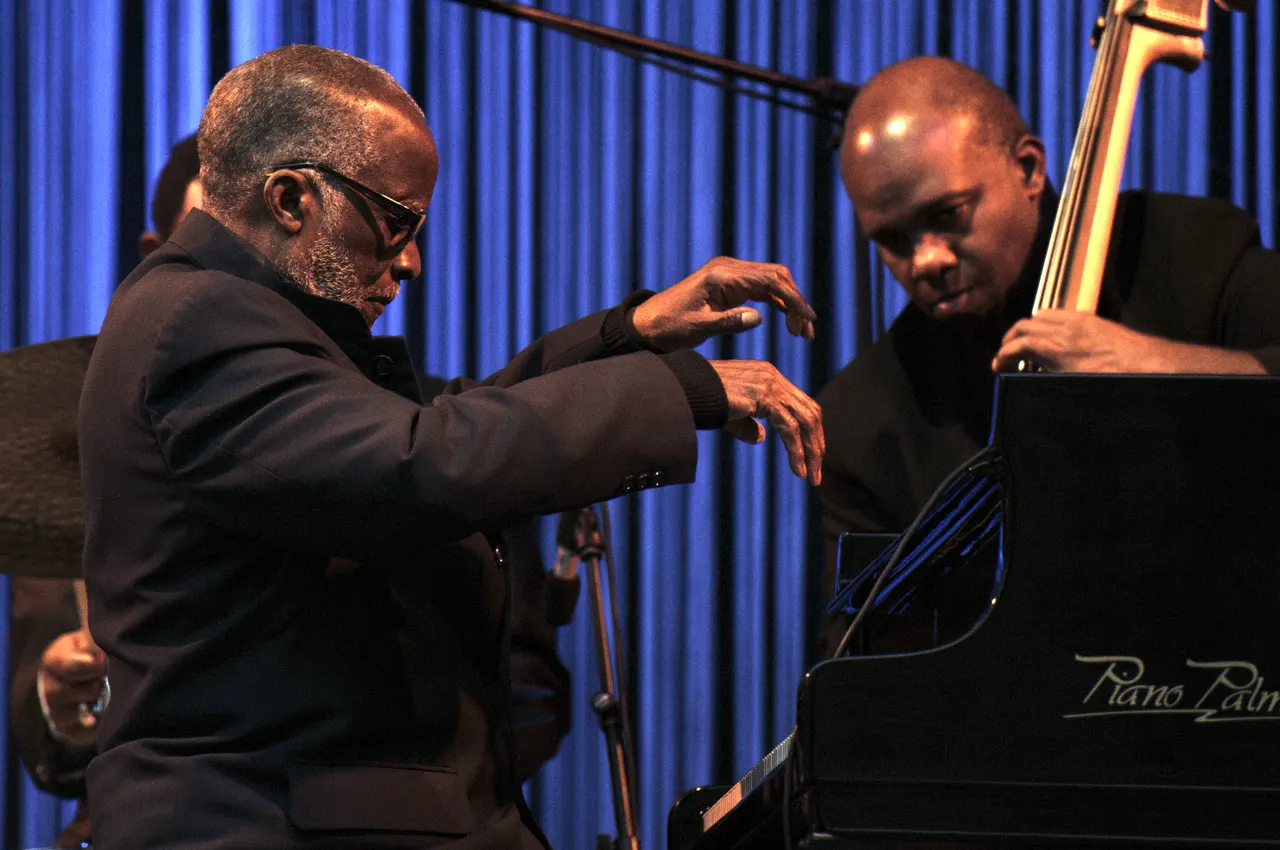
July 2, 1930 (Pittsburgh, Pennsylvania)April 16, 2023
Ask about Ahmad Jamal and you will be told about space. The silences. The restraint. What he left out. It is the first thing in every obituary and it was the first thing in ours.
He heard it his whole life and he did not accept it. Asked directly, late in life, whether the space was something he consciously planned, he pushed the word away and replaced it: they call it space, he said, and he called it discipline, something acquired over decades of working in every configuration a musician can work in. Then, describing how he came to lead a band in the first place, he said the detail that ought to change how the records are heard. He had to write, because ninety percent of his material was written. His early records, he said, were written arrangements, with space in them for improvisation and soloists.
Being sparing and being an arranger are not opposites, and this page is not going to pretend he was secretly a busy player. The point is narrower and more useful. A description that stops at what he left out treats the music as subtraction, when the documented process, at least for the group that made his name, was addition: he wrote the arrangements, and the arrangements left space in them for improvisation and for soloists.
Pittsburgh, which was absurd
Frederick Russell Jones was born in Pittsburgh on 2 July 1930, into a city with a density of piano talent that sounds made up when you list it. Earl Hines was from there. So was Erroll Garner, whom he called a major influence. So was Mary Lou Williams. As a boy he delivered newspapers to Billy Strayhorn’s household.
He was at the piano at three, after an uncle challenged him to play back what he had just played and he could. Formal study started at seven, and his teacher was Mary Cardwell Dawson, who founded the first African American opera company in the country. He studied, in his own account, Art Tatum and Bach and Beethoven and Count Basie and John Kirby and Nat Cole, and he was working on Liszt. He has said he had to know European and American classical music, both, and that his mother led him to Dawson.
Sources disagree on whether he turned professional at eleven or at fourteen, and the disagreement is not important. What is important is that Tatum heard him young and called him a coming great, which is the highest single sentence any American pianist has ever received.
He converted to Islam and took the name Ahmad Jamal while on tour in Detroit. He was consistent afterwards about not treating it as a costume change.
The Three Strings, which had no drummer
His first records, in 1951 for Okeh, were made by a group called the Three Strings: piano, guitar and bass, with Ray Crawford on guitar and a rotating bass chair that settled on Israel Crosby. The band got an extended run at Chicago’s Blue Note and then broke through at the Embers in New York, where John Hammond, who had already found Billie Holiday and Count Basie, heard them and signed them.
Two details are worth holding.
The first is that there were no drums. When you build a group without a drummer, somebody has to carry time, and the answer in that band was Crawford tapping the body of his guitar. The drums arrive in 1956, on Count ’Em 88 with Walter Perkins, and Perkins is documented as adapting the very rhythm Crawford had been playing on wood. The rhythmic idea came first. The instrument was fitted to it afterwards, which is the opposite of how most bands are assembled.
The second is that Jamal disliked the word trio and avoided it, for groups of exactly that shape, across his whole career. He did not leave a tidy explanation of why, at least not one we could find. What he left instead is the practice: arrangements with parts in them, rather than three players taking turns.
The Pershing
On 16 January 1958, at the Pershing Hotel in Chicago, Jamal, Crosby and drummer Vernel Fournier recorded the set that became At the Pershing: But Not for Me. Some accounts have the sessions running across 16 and 17 January.
It sold like nothing in its category was expected to. Different sources put it on the Billboard album chart for 107 or 108 weeks. By August 1958 DownBeat had its sales past 47,000 at a time when 15,000 was considered big for a jazz record, and by December that year it was the number one jazz seller in a poll of retailers. The album carries “Poinciana”, which he had already recorded in 1955, but this is the version that went onto jukeboxes across the country.
The DownBeat review of it, in 1958, called the music “cocktail music”.
The same review credited Jamal’s skill and his influence on other jazz musicians, called the trio’s beat excellent, smooth, light but flexible, and then concluded that throughout, the music is kept emotionally, melodically and organizationally innocuous.
What follows is our inference and not anything the reviewer wrote. It does not read to us as a hatchet job; it reads as a listener who found the surface pleasant. We would locate the interior of this record in the arrangement and in the rhythm section, and we suspect those are not where a critic in 1958 was listening for it. Ethan Iverson has made the related observation that the critics who filed Jamal as a cocktail pianist were apparently unable to hear what Crosby and Fournier were contributing.
What is actually happening in the hands
The space is structural, not decorative. Jamal thins the piano deliberately, and the reason is audibility. If the piano is playing continuously, the bass and drums are texture. If the piano stops, they become content, and you hear that Crosby is playing a line and Fournier is playing a composition. His own framing of it is exact: you have to respect what they call a rest, and you have to respect openness as well, and when it gets too congested, too complicated, something is wrong.
He arranges standards rather than playing them. This is the part a description built on restraint leaves out. He adds introductions, vamps, ostinatos and counter-rhythms, so that a familiar tune arrives layered against material it did not come with. The song is no longer a chord sheet to blow over. It is a piece with sections.
Think of it as a big band at conversational volume. The block chords come down from Erroll Garner, and Jamal deploys them the way an arranger writes a section soli, with figures a horn section could play. The concept is orchestral: a three-piece band thought of the way an arranger thinks of a band, rather than a soloist plus support.
The left hand can go into the engine room. On the Pershing recording, where another pianist would lay chords under the melody, the left hand drops onto the off-beat and joins the bass and drums rather than accompanying over them. Treat that as a documented texture in particular passages and not as a standing rule: the same hand plays the block chords described in the paragraph above. Miles Davis noticed this specifically and pushed his own pianist, Red Garland, towards it.
Dynamics are treated as a third dimension, alongside harmony and rhythm. He would drop to a level that makes a room lean forward and then arrive at full weight without warning, and he described the principle as a single rule with three halves: you cannot play loud all the time, you cannot play soft all the time, and you cannot play all the time. The practical consequence is that a loud chord from him carries information, because the quiet around it was constructed on purpose and not merely arrived at.
And the famous drum part is intricate rather than spare. The “Poinciana” beat is Fournier’s, and Fournier was always quick to explain it: he condensed a New Orleans brass band beat onto a drum kit. The cymbal off-beat is played with the left hand and the low tom with the right, a sticking that looks backwards until you picture a marching drummer with the drum strapped to the chest and a small cymbal mounted on it. Nothing about that is empty. It is a street parade compressed to a nightclub.
Three things worth stealing, in ascending order of difficulty:
- Stop playing for two bars in the middle of a chorus and do not fill the gap. Not as an effect. Listen to what your bass player and drummer are actually doing, which you have probably never heard.
- Write an introduction and a vamp for one standard you already know. Eight bars in front, four bars that recur. You have just done the thing that separates Jamal from a pianist playing the same tune.
- Put a left-hand chord on every upbeat, the and of each beat, for a whole chorus, changing the chord with the tune, instead of comping freely underneath yourself. This is an artificial coordination drill rather than a transcription of anything: the point is to feel fixed pulse against free punctuation, which is the choice the Pershing texture is making. It will feel wrong for about thirty seconds and then the band will lock.
Miles, and the problem with the Miles story
Miles Davis went to Chicago to hear him and said so at length. In an interview with Nat Hentoff published in the Jazz Review in December 1958, Davis said: “Listen to the way Jamal uses space. He lets it go so that you can feel the rhythm section and the rhythm section can feel you. It’s not crowded.” A few sentences later comes the line everybody quotes: “I live until he makes another record.”
Davis then took Jamal’s repertoire. “Ahmad’s Blues”, “Autumn Leaves”, “Surrey with the Fringe on Top”, “New Rhumba” and more turn up in the Davis book after Davis had heard Jamal play them.
Here is the problem, and it is a problem about how history gets written rather than about either musician. The Davis endorsement has become the whole story. Jamal is introduced as the man Miles loved, which quietly makes him a supporting character in someone else’s biography. He formed his own group in Chicago in 1951 and was still touring and recording into his eighties. The influence ran outward from him.
The Alhambra, which is the part nobody tells
In 1961 Jamal opened a restaurant and club in Chicago called the Alhambra, and he served no alcohol in it. He wanted a home room he could work from, so that a life of touring could become a life of playing in one place.
It failed in months. A Chicago Tribune columnist put the blame on the dry bar in December 1961. Jamal’s own account is plainer: running a group and a restaurant with a staff of over forty was, he said, too big a challenge, and his place was in music.
What followed was worse. The trio with Crosby and Fournier wound up in 1962 after the recordings that became Ahmad Jamal at the Blackhawk, and in August of that year Israel Crosby died of a heart attack at forty-three. Jamal recorded Macanudo with an orchestra and then stepped away from performing for a while.
Every account of a jazz career is a list of records. Strip the records out and what 1961 and 1962 hold is a man in his early thirties losing the room he had built, then the band, then the bassist he had worked with since the middle of the decade, four years after the record that made his name. He came back, and he was still making albums in his eighties. That is the part the master-of-space framing has no room for.
The Awakening, and the second audience
In February 1970, at Plaza Sound Studios in New York, Jamal recorded The Awakening with Jamil Nasser on bass and Frank Gant on drums. It is a trio record, acoustic, and it is the one that reached a second audience two decades later without him doing anything at all.
Pete Rock built “The World Is Yours”, from Nas’s Illmatic, on a passage from its “I Love Music” in 1994. DJ Premier took a different section of the same track for Jeru the Damaja’s “Me or the Papes”. Jamal’s reading of Herbie Hancock’s “Dolphin Dance”, from the same record, became the piano in Common’s “Resurrection”. Samples of him turn up across De La Soul, Gang Starr and a generation of records made by people who were not born when the Pershing tapes rolled.
Our reading of why, again offered as ours and not as documented producer testimony: a loop needs air in it, and records where the piano stops are rare. The quality that read as absence in 1958 was, thirty years later, the usable thing.
American classical music
He did not like the word jazz and said so for decades. He preferred a term he said he coined himself, American classical music, and in 1982 he released a live album called American Classical Music in case anyone had missed the point.
His argument was not vanity. It was that the word does not describe the work: a musician in this field has to know both bodies of music, he said, naming Brubeck having to know Mozart and Ellington, and Shearing being able to play the concertos and write “Lullaby of Birdland”. He called himself and his colleagues, including Coltrane and Ellington, American classicists, and he was explicit that he was not paranoid about the other word, he simply did not think it defined what they did.
Underneath the terminology is a lifetime of watching a category be used to price the work cheaply. He was a lifelong critic of the entertainment business and blunt about African American artists being fleeced by it. He also insisted that there was no hierarchy between the European repertoire and the American one in what mattered, and that either way you had to know what you were doing.
The long third act
In his eighties he was still touring and recording: Saturday Morning in 2013, Live at L’Olympia with Yusef Lateef in 2014, Marseille in 2017, and Ballades, mostly solo piano, in 2019, drawn from sessions cut in 2016. The archive opened alongside the new work: three volumes of Emerald City Nights, from tapes of his Seattle Penthouse engagements across 1963 to 1968, appeared late in his life and were produced under his own supervision.
He was made an NEA Jazz Master in 1994, honoured as a Living Jazz Legend by the Kennedy Center in 2007, and given a Grammy Lifetime Achievement Award in 2017.
He died on 16 April 2023 in Ashley Falls, Massachusetts, of prostate cancer, aged ninety-two.
What is documented and what is a story
Corrections to our own app. Our entry described The Awakening as having electric bass. It does not: Jamil Nasser plays acoustic bass and Frank Gant plays drums, and the record’s reputation rests on an acoustic trio. Our Emerald City Nights entry gave a single year for a set that spans two.
Two quotations we could not stand behind. Our entry carried two lines in quotation marks that we could not trace to anything Jamal is documented as saying. They are gone, replaced by words he is on record as using. This matters more on this page than most: the whole argument here is that he was misdescribed, and inventing a quotation to make him sound wise is the same failure in a nicer suit.
And the framing itself. Our app entry filed him under Minimalist and sold a less-is-more philosophy, which is the description this page spends two thousand words complicating. Leaving that in the app while arguing against it here would have been two surfaces telling a reader different things about the same man, so the app entry now leads with the arranging as well. The word space stays on both, because it is what everybody searches for and because it is not wrong. It is just the smaller half of the story.
Where to start, honestly
At the Pershing: But Not for Me, and do not listen to the piano. Listen to Fournier for one whole play of “Poinciana”, then listen again for Crosby, then listen a third time for the piano and notice how little of the record it is actually carrying.
Then The Awakening, for the arranger at full strength in a different decade.
Then put on any pianist you love and count how many bars go by without a piano in them. That number, and not the note count, is the measurement his records make you take.
Start with these records
- At the Pershing: But Not for Me 1958
It stayed on the Billboard album chart for 107 or 108 weeks, and by December 1958 it was the number one jazz seller in a poll of retailers. 'Poinciana' from this set went onto jukeboxes across the country. - The Awakening 1970
The acoustic trio at full strength - Jamil Nasser on bass, Frank Gant on drums. Hip-hop producers mined this record for decades; 'I Love Music' became the piano in Nas's 'The World Is Yours'. - Ahmad Jamal Trio 1956
Early trio work showing his concept developing. Elegant, swinging, and sophisticated. - Emerald City Nights: Live at the Penthouse 1965–1966
Unreleased Seattle club tapes, issued in volumes that each span two years and produced under Ahmad's own supervision. Hear the dynamics and the arranging in real time.
How to listen
- If you are starting out
- 'But Not for Me' (live version from Pershing) - hear the space, the dynamics, the orchestral concept. Accessible and brilliant!
- If you can already comp through a standard
- 'Poinciana' - study how Ahmad uses repetition and builds intensity through dynamics, not just more notes.
- If you are transcribing
- Take one standard he recorded and map what he ADDED to it: any introduction, vamp, ostinato or counter-rhythm. Write the map out. That is the part of his method you can actually steal.
Sources
Every year cited, every album title set in italics and every quotation on this page matches the app's own record or a claim in the site's fact file that cites at least two sources on different websites. Where sources disagree, the page says so instead of picking the better story.
- BMI Remembers Jazz Legend Ahmad JamalBMI
- Requiem for the AlhambraDan Epstein
- Emerald City Nights: Live At The Penthouse 1963-1964 / 1965-1966DownBeat
- TT 240: Ahmad Jamal. At the Pershing: But Not for Me. Argo LP-628Ethan Iverson, Transitional Technology
- Golden Age Thursday Samples: Ahmad Jamal Trio's I Love Music becomes iconic hip-hop melodyGlide Magazine
- Ahmad Jamal: Emerald City Nights: Live at the Penthouse 1963-1964/1965-1966JazzTimes
- Interview w/ Ahmad JamalJoe Alterman
- Pianist Ahmad Jamal's music career is one of great discoveryKNKX Public Radio
- Ahmad Jamal, measured maestro of the jazz piano, dies at 92 (NPR syndication)KUTX
- When Hip Hop Found Jazz: How Ahmad Jamal Became a Producer's Best FriendLush Life Records
- Ahmad Jamal: Piano Master of Technique, Dynamics and ControlMosaic Records
- Ahmad Jamal (NEA Jazz Master interview)National Endowment for the Arts
- Ahmad Jamal: Interview 1National Jazz Archive
- Ahmad Jamal, measured maestro of the jazz piano, dies at 92NPR
- Ezz-theticsPoint of Departure
- Emerald City Nights: Live At The Penthouse 1966-1968Record Store Day
- The Ahmad Jamal Live Performances With Israel Crosby and Vernel Fournier 1958-62Stuart Nicholson
- Diggin' the Gaps: How Ahmad Jamal Re-Tooled JazzThe Brooklyn Rail
- Remembering Ahmad JamalThe Common Reader, Washington University
- Ahmad Jamal and hip-hopThe Ethan Hein Blog
- Ahmad Jamal obituaryThe Guardian
- Ahmad Jamal and Me...Vinyl Magic
- Ahmad JamalWikipedia
- At the Pershing: But Not for MeWikipedia