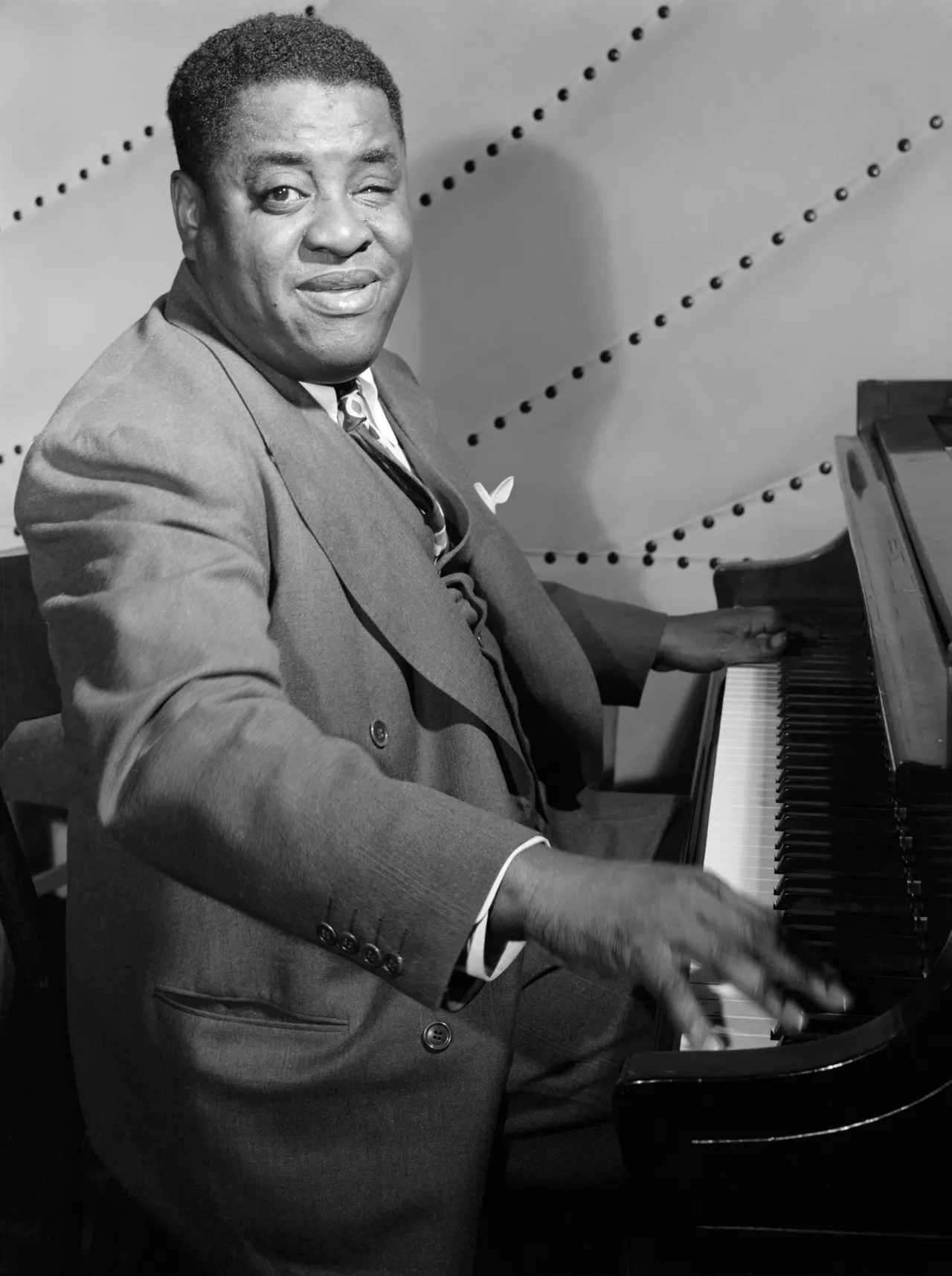
October 13, 1909 (Toledo, Ohio)November 5, 1956
There is a particular noise a pianist makes on hearing Art Tatum properly for the first time, and it is not applause. It is a short, unhappy laugh. Hank Jones, already a serious player, heard the 1933 recording of “Tiger Rag” and wanted to know who the other pianists on it were. There are no other pianists on it. Oscar Peterson’s version of the same experience is bleaker and better documented: he told André Previn that after first hearing Tatum, “I gave up the piano for two solid months and had crying fits at night.”
That reaction is the whole difficulty with writing about Tatum. The technique is so conspicuous that it eats the conversation, and eighty years of jazz writing has obliged by treating him as a circus act with perfect pitch. The speed is real. It is also the least interesting thing about him. What he actually did was take the harmonic vocabulary of American popular song and rebuild it, in public, roughly a decade before the musicians who get the credit for that rebuilding turned up to do it. If you play jazz piano today, you are using his furniture.
Toledo, and a piano roll played twice
Arthur Tatum Jr. was born in Toledo, Ohio on 13 October 1909, to a mechanic who played guitar and a mother who played piano. Cataracts left him blind in one eye with limited vision in the other for his whole life. The prodigy story — hymns and radio tunes picked out at three, an ear that fixed anything on first hearing — is one of the few that survives contact with the record.
The formative detail is not the blindness, it is the piano roll. Tatum learned by memorising rolls, and a roll cut by a stride player frequently carries more notes than two hands can produce, because the arranger punched in extra voices afterwards. A child copying that does not know he is copying an impossibility. He simply grows hands that can do it. Whatever the exact truth of the anecdote, its fingerprint is all over the mature playing: a left hand that behaves like a second pianist rather than an accompanist.
He attended the Jefferson School in Toledo, moved to the School for the Blind in Columbus late in 1924, then transferred to the Toledo School of Music. His formal teacher, Overton G. Rainey, was himself visually impaired, did not improvise, and discouraged his students from playing jazz — which is as good a reason as any to conclude that Tatum was substantially self-taught. He was probably being paid to play around Toledo from about 1924, formed his own small band in 1926, and by around 1927 had his own programme on the local station WSPD. None of those broadcasts survive. That is the most frustrating hole in the discography: we have no idea what the teenager sounded like, only what he sounded like the first time a commercial microphone was pointed at him, by which time he was already finished.
Musicians passing through the Midwest heard him and told him to go east. He stayed put for years anyway, working Toledo, Cleveland and Detroit, apparently unconvinced. The move came in 1932 and it came sideways: the singer Adelaide Hall was touring with two accompanists, one left, and Tatum took the chair. On 5 August 1932 he made his first studio recordings behind her, and five days later he cut a solo test pressing of “Tea for Two” that nobody released for decades. He was twenty-two, in New York, recording what would become his signature piece on a session booked for somebody else.
The afternoon that ended the argument
His first solo New York job was the Onyx Club on 52nd Street, for a wage later reported as forty-five dollars a week and free whiskey. Then, on 21 March 1933, he recorded four solo sides for Brunswick: “St. Louis Blues”, “Sophisticated Lady”, “Tea for Two” and “Tiger Rag”.
The fourth one did the damage. “Tiger Rag” runs at roughly 376 quarter-note beats per minute with the right hand laying even eighth notes across the top of it. That was not a tempo at which anybody was playing anything in 1933, and it is not a tempo at which most people are playing now.
Listen past the speed, though, and the session is stranger than its reputation. Leonard Feather, writing the notes for the reissue that eventually collected these sides, named the thing everyone misses: “the incessantly creative left hand, now striding, now playing four different chords to the bar”. Four chords to the bar. In 1933 the left hand’s job description was a bass note and a chord, twice, repeat. Tatum treated it as a harmonic instrument with its own agenda, which is why his records do not sound like a solo over an accompaniment. They sound like two players who happen to agree.
He kept recording through the decade, mostly for Decca. He worked clubs out west through the lean years of 1934 and 1935, married Ruby Arnold in August 1935, took a residency at Chicago’s Three Deuces, appeared on national radio including Rudy Vallee’s programme in 1935, fronted a sextet in 1937, and spent three months in England in 1938. There is an old line that Tatum could not play with other people. It is exactly backwards. The problem was never that he could not accompany; it was that his accompaniment was so dense and so mobile that a sideman had to be extraordinary to survive inside it.
What is actually happening in the hands
This is the section most Tatum profiles skip, and the one that matters if you play.
He improvised harmony, not melody. Most jazz improvisers keep the chords and invent a new line over them. Tatum inverted it. Unusually for a jazz musician he rarely abandons the written tune: he states or implies the original melody, or a fragment of it, and builds the invention underneath and around it — which is exactly why the records stay listenable rather than becoming an endurance test. Britannica’s summary of the method is the most useful sentence written about him: he inserted entirely new chord progressions, sometimes a new chord on every beat, into the space of one or two bars. Not a substitution here and there. A different harmonic route through the same eight bars, invented at tempo.
The bebop devices are already there. Tritone substitution, altered dominants, chains of secondary dominants interpolated into one static bar, whole voicings sliding chromatically by half step. These are audible in the 1933 sides. The beboppers did not invent them; they abstracted them out of a pianistic context and rebuilt them for horns, where a single line has to imply what ten fingers had been stating outright. What bop took from Tatum, above all, was the principle that you may drift away from a tonal centre and come back.
Three things worth stealing, in ascending order of difficulty:
- Harmonise the same eight bars four ways before you play them once. It costs nothing and it is the whole method in miniature. Take a tune you know cold. Keep the melody note for note. Change only what is underneath it.
- Treat the ii–V as expandable. Where the chart gives two bars, Tatum habitually gives himself four chords, then six, walking a cycle of dominants into the target instead of sitting on the V. Each interpolated dominant can then take a tritone sub, and that is where the chromatic bass lines in his playing come from.
- Give the left hand something to say. Not four chords to the bar on day one. Start with two: stride bass on one and three, and a genuinely different voicing — not an inversion, a different chord — on two and four.
The runs are harmony, not decoration. The standard complaint about Tatum, made by good critics for eighty years, is that he is too ornamental. The complaint mistakes the ornament for a surface. A Tatum run is usually not a scale. It is an arpeggiated statement of the substitute chord he has just decided to impose, played fast enough to register as a gesture, so the harmony arrives as colour rather than as an announcement. Slow one down and it stops being a flourish and becomes an analysis.
And there is more dissonance than you think. The musicologist Lewis Porter picked out three things a casual listener misses: the dissonance inside the chords, the substitute progressions, and the occasional bitonality — two keys at once. There are examples of the last on record as early as 1934, which puts Tatum further out harmonically than anyone else in jazz until Lennie Tristano. Whole-tone and diminished sonorities run through the playing as ordinary connective tissue, decades before either became standard bandstand vocabulary.
After hours, which is where he actually lived
The commercial records are only part of him. In a professional setting Tatum tended to play his tunes close to the recorded versions and often declined encores. In after-hours sessions he played blues, stretched out over the same changes for far longer, wandered much further from the melody, and sometimes sang — Gunther Schuller described the voice as night-weary and slurry, singing material that would have appalled the fans who admired him for his discipline.
In November 1940 a Columbia University student named Jerry Newman began carrying a portable disc cutter into Harlem clubs and recording Tatum informally, and kept at it through 1941. Newman caught him at Reuben’s on West 130th Street, a small room where the owner kept time by brushing two whiskbrooms over a folded newspaper laid on a chair. He caught him in duet with the trumpeter Frankie Newton on “Sweet Georgia Brown” and “Lady Be Good”. He caught him singing the blues, happily.
Those acetates were issued in 1973 as God Is in the House and won two Grammy Awards. The title comes from the most famous Tatum anecdote there is: Fats Waller, working a club, saw Tatum come through the door and told the room that he himself only played the piano, but that God was in the house tonight. Waller was Tatum’s stated main influence and his friend, so the line is affectionate as much as awed, and the two facts together tell you more about the Harlem piano world than any amount of technical description.
The trio, the concert, and Norman Granz
By 1943 Tatum could reportedly command around three hundred dollars a week as a soloist. When he formed a trio later that year with the guitarist Tiny Grimes and the bassist Slam Stewart, booking agents advertised the group at seven hundred and fifty. It worked. On 52nd Street the trio drew better than almost anyone, Billie Holiday possibly excepted, and it put Tatum on film for the first time, playing “Tiny’s Exercise” for an episode of The March of Time. Stewart’s bowed solos, hummed in unison, and Grimes’s fast single-note lines gave the group a character that was not simply Tatum plus support.
He walked away from it in 1944 and did not record with a trio again for eight years. Early in 1945 the Downbeat Club on 52nd Street was reportedly paying him one thousand one hundred and fifty dollars a week for four twenty-minute sets a night — an unheard-of figure — and a Billboard reviewer noted that in exchange he was given a broken-down instrument, bad lighting and nothing else, and was inaudible past the front rows over the noise of the room.
In the spring of 1949 he played a solo concert at the Shrine Auditorium in Los Angeles, promoted by Gene Norman as part of his “Just Jazz” series, and somebody recorded it. Sources disagree on the exact date — some give early April, others May — but nobody disagrees about the playing. It produced the “Yesterdays” that became one of his set pieces: a slow out-of-tempo introduction, then a boogie bass arriving underneath a right hand that goes off like a firework. It produced an “I Know That You Know” and a “Tatum Pole Boogie” at tempos that are difficult to accept, and his variations on “Humoresque”, which is Dvořák taken somewhere Dvořák would not have followed. Columbia issued the concert as Gene Norman Presents an Art Tatum Concert in 1952, and in 1968 paired it with the four 1933 Brunswick sides as Piano Starts Here. That remains the correct first Tatum record to own.
Then, in late 1953, Norman Granz. Granz’s method was volume: he told Tatum to record whatever he liked and kept the tape running. Across two days at the end of December 1953 Tatum laid down close to seventy solo performances, nearly all of them first takes with no playbacks — a feat of memory and stamina with no real parallel in the music. Sessions in April 1954 and January 1955 pushed the total past a hundred and twenty. The results appeared as the multi-volume The Genius of Art Tatum and were later gathered as The Art Tatum Solo Masterpieces.
They are also, in stretches, the weakest important records he made, and it is worth saying so out loud. With no preparation and a long list of standards to get through, many of the performances land at around three minutes with the arrangement stated and not developed. Scott Yanow’s verdict — workmanlike, pleasing rather than miraculous — is harsh and substantially fair. Buy them for the performances where he catches fire, not as a body of work.
The companion project is the better one. Granz set out to disprove the idea that Tatum could not play with anybody else, and put him in small groups: with Benny Carter and Louie Bellson, with Roy Eldridge, with Lionel Hampton and Buddy Rich, with Ben Webster, with the clarinettist Buddy DeFranco, with Red Callender and Jo Jones. These became The Tatum Group Masterpieces, collected as The Complete Pablo Group Masterpieces, and they are a masterclass in adaptation running in both directions. Webster’s answer to the problem is to play long notes and let Tatum fill the space around them. DeFranco’s is to go at him head on. Both work. Neither man sounds like he is being drowned.
One session never happened. Granz proposed pairing Tatum with Charlie Parker, who had reportedly taken a dishwashing job at a New York restaurant where Tatum was playing largely so he could listen, and who said he wished he could play like Tatum’s right hand. Tatum did not turn up. No explanation survives.
What is documented and what is a story
Two things get repeated about Tatum, and they are not the same kind of object.
The Waller line is real and consistently reported by people who were on the street at the time.
The Vladimir Horowitz quotation is a different matter. The version usually printed is “If Art Tatum took up classical music seriously, I’d quit my job the next day”, and the honest description of it is that it is a story. The sources that carry it hedge with reportedly and according to legend, which is what writers do when the paper trail stops. What is far better attested is smaller and, frankly, better: Horowitz spent months working up his own variations on “Tea for Two”, played them for Tatum, and then listened to Tatum answer with something more startling invented on the spot. André Previn told that one to Oscar Peterson on camera. Classical pianists of the first rank turned up in jazz clubs to hear a nearly blind man from Toledo, repeatedly, and that needs no embellishment. We would rather print the attested version than the flattering one, because a page that sells a jazz theory app cannot afford to be careless with a quotation mark.
The end, and the word
By 1956 Granz had made him better off than he had ever been and he was playing prestigious rooms, including a Hollywood Bowl bill that August. He had been a heavy drinker since his teens. He fell ill with uremia — kidney failure, not the liver disease it is occasionally miscalled — and died in Los Angeles on 5 November 1956, aged forty-seven, weeks after his last performance and about two months after his final session.
Feather, in those same liner notes, wrote the sentence most obituaries would not: “He was black in a society that awarded honors to white musicians with a tenth of his talent.” Tatum spent a career in night clubs. He never had a hit, never wrote a songbook, and is the one member of the instrument’s absolute first rank whom a room full of music students can fail to recognise by name.
He did get one strange and rather perfect memorial. In 1993 an MIT student named Jeff Bilmes, working in computational musicology, needed a word for the smallest perceptible time unit in a piece of music — the fastest pulse a listener can infer. He called it a tatum. Somebody named the atom of rhythm after him.
Where to start, honestly
Begin with Piano Starts Here. Give the 1933 “Tiger Rag” three listens: one to be knocked over, one with a metronome running so the tempo becomes a fact rather than an impression, and one with your hands on a keyboard trying to work out what the left hand is doing on beats two and four. Then take the 1949 “Yesterdays” and find where the key actually is at every moment. Then God Is in the House, for the man rather than the monument.
And then reharmonise any standard you already know, tonight, badly. Four different sets of chords under the same eight bars. You will not sound like him — nobody does, which is why he founded no school while influencing everybody — but you will be doing the thing he was actually doing, which was never really about speed.
Start with these records
- Piano Starts Here 1968
The place to start. A Columbia compilation: his first solo session, recorded March 1933, plus his 1949 Shrine Auditorium concert. Features 'Tea for Two' - hear him transform a simple tune into a masterpiece! - The Complete Pablo Group Masterpieces 1954–1956
Art with bass and drums, recorded 1954-1956 near the end of his life. Captures his mature style with stunning clarity. - The Tatum Solo Masterpieces 1975
The Norman Granz marathon solo sessions, taped 1953-1955 and issued as a Pablo series two decades later. Pick any volume - they are all incredible. Essential for serious pianists. - The Standard Transcriptions 1949
Radio transcriptions from 1949. Excellent sound quality for the era. Hear Art's unmatched virtuosity clearly.
How to listen
- If you are starting out
- 'Tea for Two' - hear him take a simple tune and make it magical. Accessible yet mind-blowing.
- If you can already comp through a standard
- Compare Art's version of 'Tiger Rag' to others. Notice his reharmonizations and how he builds intensity.
- If you are transcribing
- Transcribe any Art Tatum solo (prepare to be humbled!). Analyze his reharmonization choices. They are decades ahead of their time.
Sources
Every year cited, every album title set in italics and every quotation on this page matches the app's own record or a claim in the site's fact file that cites at least two sources on different websites. Where sources disagree, the page says so instead of picking the better story.
- The Art Tatum Solo Masterpieces, Vol. 1 (OJC Remasters)Concord Music Group
- Art Tatum: God Is In The House (Onyx 205)Dave Ratcliffe Piano
- Art Tatum – Piano Starts Here (Columbia CS 9655, 1968)Discogs
- Art TatumEncyclopaedia Britannica
- Art Tatum 1909–1956Encyclopedia.com
- 15 Most Asked Questions About Vladimir HorowitzInterlude
- Art Tatum: Tatum ArtJazzTimes
- Art Tatum: No Greater ArtJazzTimes
- Rhythm — the tatumMUsic Technology Online Repository
- Art Tatum, Vladimir Horowitz, and Other GreatsNational Review
- Art Tatum: A Talent Never to Be DuplicatedNPR
- Who was Art Tatum?Sheet Music Library
- Art Tatum (October 13, 1909 – November 5, 1956)Sooze Blues & Jazz
- Art Tatum: God Is in the House — album notes (Dan Morgenstern)Texas State University document archive
- Granz' Art Tatum Recordings: A Piano Method for JazzThe Art Music Lounge
- Art Tatum: "Have You Met Miss Jones?"The Listeners' Club
- Influence and Art TatumThe Syncopated Times
- Art Tatum: Profiles in JazzThe Syncopated Times (Scott Yanow)
- Art Tatum: Piano Starts HereThe Syncopated Times (Scott Yanow)
- Art TatumWikipedia
- God Is in the House (Art Tatum album)Wikipedia
- Gene Norman Presents an Art Tatum ConcertWikipedia
- Tatum (music)Wikipedia
.jpg)