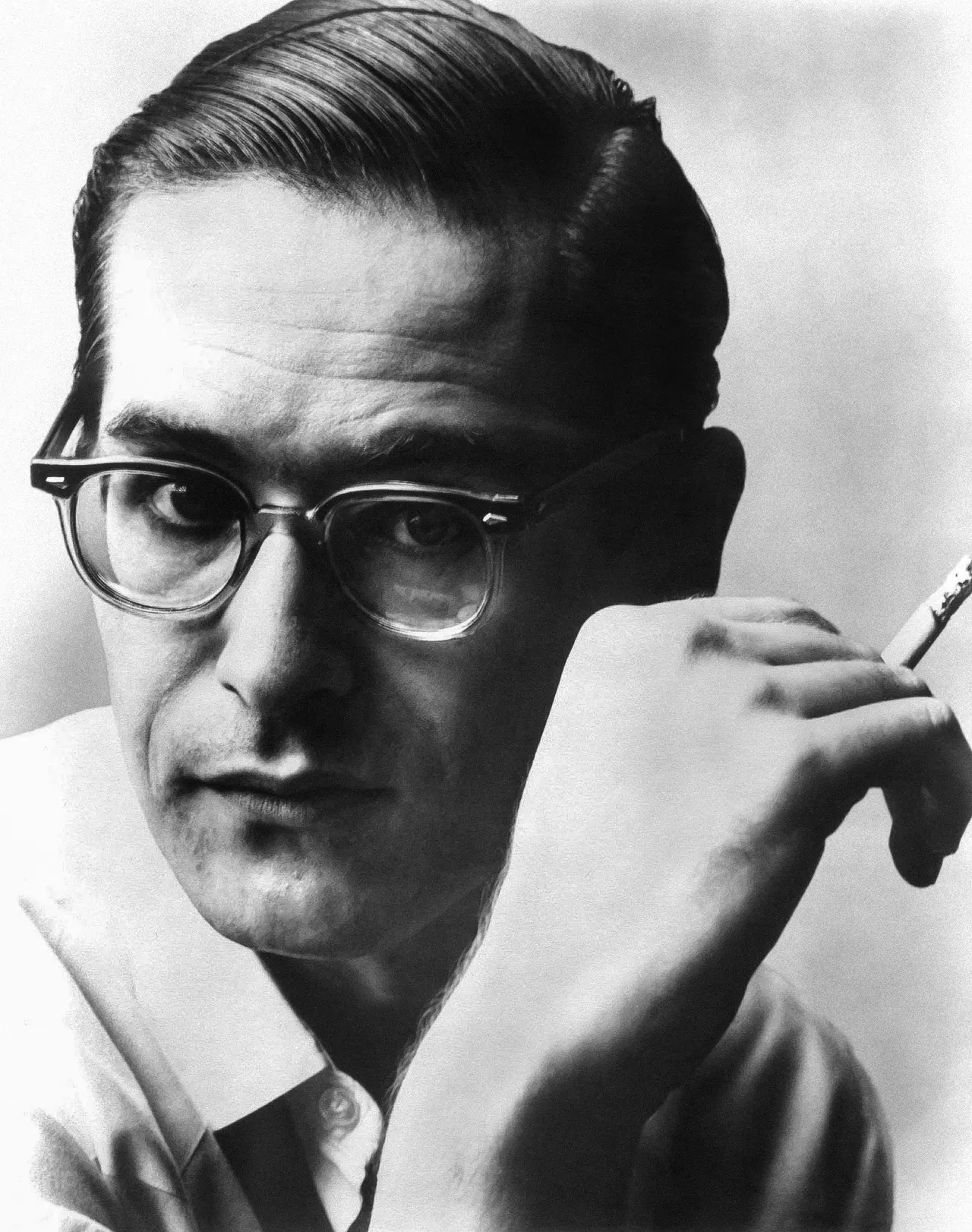
August 16, 1929 (Plainfield, New Jersey)September 15, 1980
There is a comfortable story about Bill Evans and it goes like this: a shy, bespectacled classicist wandered into jazz, brought Debussy with him, played very beautifully, took too many drugs and died. It is not false. It is just useless, because it explains the mood and not the influence, and the influence is the thing that ought to interest anyone who plays.
Here is a better way to see the size of him. Sit at a piano and play a D minor seventh the way a jazz pianist plays it — left hand, no root, F below middle C at the bottom, then A, then C, then E. That is not a folk custom. That is a specific solution to a specific problem, and it became the default. Teachers who have never met each other, on different continents, call it a Bill Evans voicing. Having a chord shape named after you by people who teach for a living is a stranger and larger kind of influence than writing a famous tune.
Plainfield, and a very long apprenticeship
William John Evans was born in Plainfield, New Jersey on 16 August 1929. He was not a prodigy in the Tatum sense — no legend of a three-year-old at the keyboard, no cutting contests won at fifteen. He was a diligent, exceptionally literate musician who read at concert standard, took a degree at Southeastern Louisiana in 1950, did his army service, and arrived in New York in his mid-twenties having already absorbed Debussy, Ravel, Bach and Stravinsky as working vocabulary rather than as decoration.
That literacy is the whole story of what happened next, and it is worth being precise about why. A pianist who has genuinely internalised French impressionist harmony does not hear a dominant seventh as a dominant seventh. He hears a collection of available colours with a function attached, and he is comfortable choosing which of those colours to sound and which to leave out. Jazz in 1956 did not think that way. Jazz thought in chords you played and chords you did not.
He worked with the composer George Russell, whose theoretical work pushed jazz toward scales and away from chord-by-chord navigation, and he recorded his first album as a leader in 1956: New Jazz Conceptions. The title was not modest and it was not wrong. Buried on it, as a short solo piano piece, is “Waltz for Debby”, written for his niece. He would play it for the rest of his life.
Miles, 1958, and the record everyone owns
Miles Davis hired him in 1958. Evans was in the band for something under a year, and in that time he became the harmonic conscience of the most famous jazz album ever made.
Kind of Blue was recorded in two sessions at Columbia’s 30th Street Studio in New York, on 2 March and 22 April 1959, and released that August. Evans plays on everything except “Freddie Freeloader”, where Wynton Kelly takes the chair. The sound of the record — the floating, unhurried, faintly sorrowful quality that makes it the album non-jazz-listeners own — is substantially his voicing sense applied to Davis’s structural idea.
He also wrote the liner notes, and they are the best short statement of his aesthetic anyone has produced, including him:
There is a Japanese visual art in which the artist is forced to be spontaneous. He must paint on a thin stretched parchment with a special brush and black water paint in such a way that an unnatural or interrupted stroke will destroy the line or break through the parchment.
Read that as a description of touch, because that is what it is. Evans’s playing has almost no recovery in it. There is no hedging, no filling a bar while he decides. The line commits and the harmony underneath it commits at the same instant, which is why the records sound calm and are in fact extremely high-risk.
What is actually happening in the hands
This is the part that matters if you play, and it is the part the sentimental account skips entirely.
The problem he solved. Put a bass player in a room with a pianist. The bassist is playing roots. If the pianist also plays roots, the two of them double each other on the least interesting note in the chord, the low end turns to mud, and the pianist has used a finger to say something already said. In 1956 that was simply how it was done.
The solution: leave the root out and spend the finger on colour. What is now taught everywhere as rootless voicings, in two positions, is the shape most directly associated with him. In the key of C, on a ii chord:
- A position — the third at the bottom, then the fifth, seventh and ninth. On D minor seventh that is F3, A3, C4, E4. Bottom note below middle C, top note at or above it.
- B position — the same four pitches with the bottom two moved up an octave, so the seventh is now at the bottom: C, E, F, A.
Two positions exist for one reason: voice leading. Alternate them through a ii–V–I and almost nothing moves. Go from that A-position D minor seventh to the G7 beneath it and you change one note: the C drops to B. One finger. The chord changes function completely and the hand barely notices, and that is the entire trick. He is not choosing pretty chords. He is choosing the chord whose notes are already under his fingers.
A register rule, not a suggestion. Keep the bottom of the voicing roughly between the C below middle C and middle C itself. Below that the same notes stop being harmony and become a rumble. Our own method chapters carry a worked exception that is more useful than the rule: on E minor seventh, the seventh-in-the-bass shape sits inside the legal range and is still rejected as too muddy, so the third-in-the-bass version is chosen. The range is a boundary, not a guarantee, and the ear overrules it.
The So What voicing, and an honest correction. The five-note shape from Kind of Blue — three stacked perfect fourths with a major third on top — is the other structure everyone takes from this era. On a D minor seventh, bottom to top: D, G, C, F, A, with the left hand taking the root and the eleventh and the right hand the seventh, third and fifth.
It is worth saying plainly that this one does contain the root, which is exactly the sort of detail that gets lost when a shape becomes a slogan. It is not a rootless voicing wearing a different hat. It is a different object with a different job, and its real utility is that one fixed grip serves three chords, because what changes is not the shape but the root underneath it. Hold D, G, C, F, A and put a D in the bass: a minor chord with the eleventh in it and the fifth on top. Put B flat underneath the same five notes: a major seventh chord, and that same top A is now the major seventh. Put E flat underneath: a Lydian chord, and the A is the raised fourth. The hand never moves. The bass moves, and the top note means something different each time. Learn one grip, cover three situations. Those five pitches are also a pentatonic scale, which is the door through to everything McCoy Tyner would do with fourths a few years later.
Block chords, and how his differ from everyone else’s. The locked-hands texture is not his invention, but his version of it is distinctive, and here the description is our own method’s rather than a historian’s. The standard four-way close builds a four-note chord in closed position, span no wider than an octave, inverted so the melody note sits on top, with a diminished chord standing in whenever the melody note is not a chord tone. The reason that alternation works at all is the quiet identity underneath it: the passing diminished voicing is a rootless dominant seventh flat nine of the chord you are going to. B, D, F, A flat is simultaneously a diminished seventh and a rootless G7 flat nine. The texture is just a chord alternating with its own dominant.
Where the texture takes on a personality is in how those notes get split between the hands, and the split our own method teaches for this sound is a single note in the right hand over a four-note voicing in the left, rather than the weight spread evenly across both. That is a teaching choice, not a transcription of what his hands did on any particular night. What it produces is the quality the records genuinely have: the melody thin and singing, the harmony sitting under it as one block, the two never fighting for the same register. It is why a passage can be dense in harmony and still sound like a line rather than a wall.
And the thing under all of it: rhythmic independence. His melodic lines float free of the barline while the harmony underneath stays anchored, and he does it so consistently that it stops sounding like rubato and starts sounding like two musicians. This is the hardest thing on the page to steal and the most worth stealing.
Three things worth stealing, in ascending order of difficulty:
- Take the root out of your left hand for one week. Play only A and B position through every standard you know. It will feel thin for three days and then it will feel like the right thing.
- Practise the change, not the chord. Put A-position ii next to the V that follows it and find the single note that moves. Do it in all twelve keys. The fluency you are after is not chord recall, it is knowing which finger moves.
- Displace the time. Evans’s melodic lines float free of the barline while the harmony underneath stays anchored. Take a phrase you can already play and start it an eighth note late, deliberately, and land it where it belongs.
The trio, which is the actual revolution
The voicings would have made him important. The trio made him foundational.
At the end of 1959 he recorded Portrait in Jazz with the bassist Scott LaFaro and the drummer Paul Motian. Explorations followed in 1961. In these records the piano trio stops being a pianist with support and becomes three people talking. LaFaro does not walk under the piano; he plays counter-melody, argues, takes the lead line for a bar and hands it back. Motian is not keeping time so much as continuously commenting on it.
On Sunday 25 June 1961 the trio played five sets at the Village Vanguard — two in the afternoon, three in the evening — and Riverside recorded all of it. Orrin Keepnews got two albums out of that one day: Sunday at the Village Vanguard, released that October, and Waltz for Debby, released early the following year. A complete three-disc edition of every set appeared decades later as The Complete Village Vanguard Recordings, 1961, including a first take of “Gloria’s Step” that is incomplete because the power failed.
LaFaro was killed in a car accident on 6 July 1961. He was twenty-five. Accounts say ten days later and eleven days later about equally often. The calendar says eleven.
Evans stopped. He went into seclusion, and after months without public performances he reemerged with a new trio, with Chuck Israels on bass. What he said about that Sunday is the least ornamental thing he ever said:
I am thankful that we recorded that day, because it was the last time I saw Scott and the last time we would play together. When you have evolved a concept of playing which depends on the specific personalities of outstanding players, how do you start again when they are gone?
That is a technical question as much as a grieving one, and it deserves a technical answer: he did not start again. He rebuilt. Eddie Gomez joined in 1966 and stayed more than a decade. In 1963 he made Conversations with Myself, an album of overdubbed piano played against itself, which is a strange and slightly airless solution to the problem of having nobody left to talk to, and which won him a Grammy. His last trio, with Marc Johnson and Joe LaBarbera, is the one he himself said was the best since LaFaro and Motian, and the recordings bear him out.
He was also, quietly, one of the great duo players. The records with the guitarist Jim Hall are the clearest place to hear what he does when there is no drummer to imply the time, and the two albums with Tony Bennett, in 1975 and 1977, are a masterclass in accompanying a singer without ever getting underneath the words.
What is documented and what is a story
Two things here need separating, and one of them is a correction to a claim on our own app.
Who wrote “Blue in Green”. The original Kind of Blue sleeve credits Davis alone. Evans said more than once that he wrote it, and the version on Portrait in Jazz is credited to both men. Asked about it directly in a radio interview broadcast on 27 May 1979, he answered:
The truth is I did [write the music] … I don’t want to make a federal case out of it. The music exists, and Miles is getting the royalties.
Davis maintained in his autobiography that he wrote everything on the album, and later reportedly allowed that the two of them wrote it together. So the honest verdict is not that the matter is settled but that the weight sits heavily on one side: Evans’s account was specific and he repeated it, his own recording of the tune credited both men, and the royalties never moved.
The second session date is not as settled as everyone says. The standard account, and the one on the session log, gives 22 April 1959. Some discographical work places it on 6 April instead and argues the April date everyone cites was a booking that was cancelled. We give 22 April because the photographed session log supports it, and we mention the argument because a page that pretends jazz discography is tidy is lying about a field where it usually is not.
And a correction to ourselves. The app describes You Must Believe in Spring as his final studio recording. It is not, quite. It was recorded at Capitol Studios in Los Angeles across three days in August 1977 with Eddie Gomez and Eliot Zigmund, and it was that particular trio’s last studio album; he recorded further after it, and it was released in February 1981, five months after he died. The distinction matters because the record is often heard as a farewell written from the edge of the grave, and it was actually made three years earlier by a working band at its peak. It carries “B Minor Waltz”, written for Ellaine, and “We Will Meet Again” — a title now inseparable from his brother Harry, though Harry was alive when the session happened and died two years later, so whatever that tune means it was not written as an elegy for him. The record is sad enough without borrowing grief that arrived afterwards.
The end, which was not sudden
Evans was a heroin addict for much of the 1960s and moved to cocaine later. His friend Gene Lees called the whole thing “the longest suicide in history”, and the phrase has stuck because nobody has improved on it.
He worked to the end and worked well. He finished a run at the Keystone Korner in San Francisco in the first week of September 1980, playing with a force that audiences found impossible to square with how he looked. On 15 September 1980 he was taken to Mount Sinai Hospital in New York and died that afternoon, aged fifty-one. The causes listed are a peptic ulcer, cirrhosis, bronchial pneumonia and untreated hepatitis, which is less a diagnosis than an inventory. He is buried in Baton Rouge, next to Harry.
The waste is real and should not be tidied into poignancy. What survives it is not a mood. It is a method: take out what is already being said, keep what carries the meaning, move the smallest possible distance to the next chord, and let three people improvise the same music at the same time instead of one improvising and two agreeing.
Where to start, honestly
Start with Waltz for Debby and the track “My Foolish Heart”, because it is the most direct route into what the touch actually does, and because you can hear the room and the glasses. Then Sunday at the Village Vanguard for “Gloria’s Step” and “Jade Visions”, both LaFaro’s tunes, and listen to the bass, not the piano — that is where the argument is. Then Kind of Blue, which you already own, listened to once for the piano alone.
Then sit down and play a D minor seventh with no D in it, in both positions, in all twelve keys, until the change to the V costs you one finger. That is a dull week and it is the actual inheritance.
Start with these records
- Portrait in Jazz 1960
First album with the legendary Scott LaFaro trio. Hear the birth of conversational trio playing. Check out 'Autumn Leaves' for revolutionary bass-piano interaction. - Sunday at the Village Vanguard 1961
Recorded at the Village Vanguard on June 25, 1961, eleven days before LaFaro died. Raw, live energy showing the trio at its peak. 'Solar' and 'Gloria's Step' are masterclasses in interaction. - Waltz for Debby 1962
From the same June 25, 1961 Village Vanguard session, released early in 1962. The title track is one of the most beautiful jazz performances ever recorded. Perfect introduction to Evans' lyrical side. - You Must Believe in Spring 1981
Recorded August 1977 with Eddie Gomez and Eliot Zigmund, released after his death. Mature, reflective playing showing a lifetime of harmonic exploration. Heartbreakingly beautiful.
How to listen
- If you are starting out
- Start with 'Waltz for Debby' (the song). It is gentle, beautiful, and accessible. Then try 'My Foolish Heart' - pure poetry.
- If you can already comp through a standard
- Dive into 'Sunday at the Village Vanguard' full album. Focus on how the trio interacts. Count the bars they trade!
- If you are transcribing
- Study 'Nardis' from multiple albums over the years. Notice how his harmonic concept evolved. Transcribe his voicings!
Sources
Every year cited, every album title set in italics and every quotation on this page matches the app's own record or a claim in the site's fact file that cites at least two sources on different websites. Where sources disagree, the page says so instead of picking the better story.
- Bill Evans jazz piano biography and albumsAll About Jazz
- Bill Evans on Miles Davis and Kind of BlueAllan Chase
- You Must Believe in Spring, tracks and reviewsAllMusic
- About Bill EvansBill Evans Official Site
- Waltz for Debby and Sunday at the Village Vanguard reissuedBill Evans Official Site
- Sunday At The Village Vanguard album pageConcord Music Group
- Bill Evans' posthumous tour de force, You Must Believe in Spring, set for reissueConcord Music Group
- Rootless Left Hand Piano VoicingsEarl MacDonald
- Bill Evans research starterEBSCO
- Bill Evans, jazz pianist and composerEncyclopaedia Britannica
- Bill Evans, left hand voicings and fourths voicingsJohn Elliott's Blog
- Bill Evans facts for kidsKiddle
- Kind Of Blue album pageMiles Davis Official Site
- Why Does Kind of Blue Endure?New York Jazz Workshop
- Rootless Chord Voicings for Jazz PianoPianoGroove
- Bill Evans: Live, '64-'75Robert Doerschuk
- Music History Monday: William John EvansRobert Greenberg Music
- Improvisations in Jazz, Bill Evans' Kind of Blue liner notesThe Dewdrop
- Bill Evans You Must Believe In Spring ResurrectedTracking Angle
- Bill EvansWikipedia
- Waltz for Debby (1962 album)Wikipedia
- Kind of BlueWikipedia
- Sunday at the Village VanguardWikipedia
- The Complete Village Vanguard Recordings, 1961Wikipedia
- Blue in GreenWikipedia
- You Must Believe in Spring (Bill Evans album)Wikipedia

.jpg)