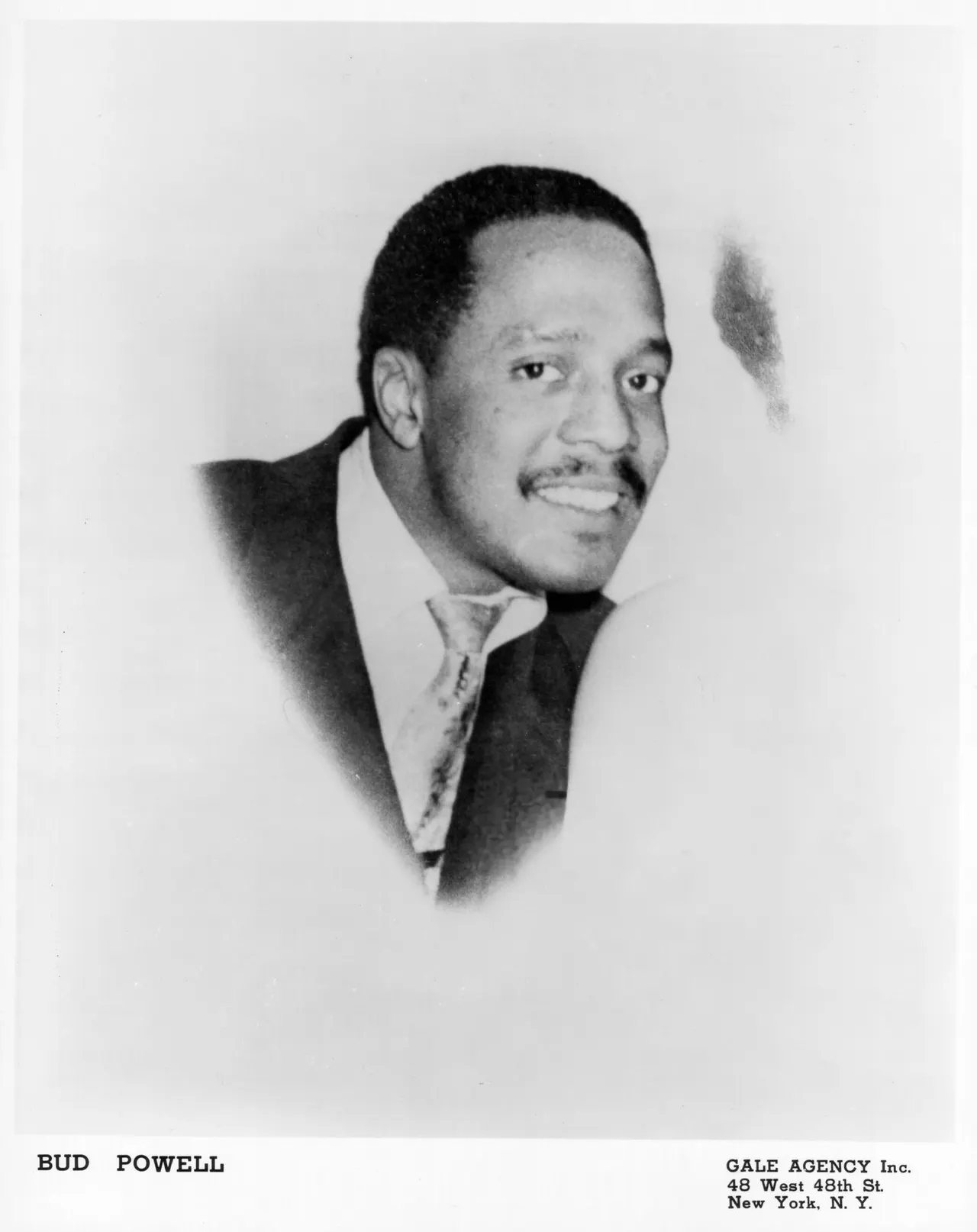
September 27, 1924 (New York City, New York)July 31, 1966
Bebop broke the piano. That is the fact everything about Bud Powell follows from, and it is usually skipped.
By the mid-1940s the new music was being played at tempos and with a harmonic density that horn players could handle, because a horn plays one note at a time and a saxophonist has both lungs pointed at a single line. The piano had spent thirty years developing the opposite skill: the left hand kept the time and the bass and the harmony, all at once, in the stride tradition. Put a stride left hand under a bebop right hand at two hundred and eighty beats per minute and you get mud. Two people are talking, both of them are you, and neither can be heard.
Powell’s answer was so complete that it stopped looking like an answer and started looking like the way things are.
Harlem, and a very fast start
Earl Rudolph Powell was born in Harlem on 27 September 1924, into a musical family, and was a known quantity in the neighbourhood while still a teenager. He was underage and playing at Monroe’s Uptown House and at Minton’s Playhouse, the two rooms where bebop was being built, and he was taken up by Thelonious Monk, who was six years older and became a lifelong friend and advocate.
In 1943, at nineteen, he joined Cootie Williams’s band, which is where the wider musical world first heard what he could do. He was an outstanding sight-reader and could play faster and cleaner than nearly anybody, and his phrasing already had the percussive punctuation that came from listening to horn players rather than to other pianists.
His first recordings as a leader came in 1947, a trio date for Roost. By then he had already appeared on other people’s sessions with Frank Socolow, Sarah Vaughan, Dexter Gordon, J. J. Johnson, Sonny Stitt, Fats Navarro and Kenny Clarke, which is a reasonable summary of who mattered in that music at that moment.
Philadelphia, 1945
After a gig with the Williams band in Philadelphia in 1945, Powell — drunk, separated from the band, wandering — was beaten by police and put in a cell. He was twenty. Accounts of the night differ in detail; what is not in question is that his mother collected him from the jail and he had sustained a severe head injury.
The headaches did not stop. He was admitted to Bellevue, then to a psychiatric institution, and for the next twenty years his life ran on two tracks that barely touched: extended hospitalisations, electroshock treatment and heavy tranquillisers on one, and on the other some of the greatest piano playing anybody has recorded.
It is tempting to write the beating as the single cause of everything that followed. That is tidier than the evidence. His mental health was already declining that year and alcoholism was already part of the picture, and the honest version is that a young man in trouble was handed a head injury by the state and never got clear of either. Both things are true and neither explains the other away.
1949 to 1953, which is the work
The recordings that matter most were made in a four-year window while all of that was going on.
In August 1949 he led a quintet at WOR Studios in New York for Alfred Lion, with Fats Navarro on trumpet, a nineteen-year-old Sonny Rollins on tenor, Tommy Potter on bass and Roy Haynes on drums. That session produced “Bouncing with Bud”, “Wail”, “Dance of the Infidels” and a reading of Monk’s “52nd Street Theme”. On 1 May 1951, back at WOR with Curly Russell and Max Roach, he made the trio session that gave us “Un Poco Loco” and “Parisian Thoroughfare”. Both dates were originally issued as 78s and later gathered as The Amazing Bud Powell, Vol. 1.
“Un Poco Loco” is the one to put on if you have three minutes. Max Roach plays a clave figure on the cymbal, and Powell plays a left-hand bass line so strong that the bassist is nearly redundant while the right hand goes somewhere else entirely. The literary critic Harold Bloom later put it on a short list of the greatest works of twentieth-century American art, which is an odd sentence to write about a piano trio side and is also not wrong.
Then, in the middle of it, the machinery: a long hospitalisation from late 1951 into early 1953 after a marijuana arrest, ending with his release into the legal guardianship of Oscar Goodstein, who owned Birdland. A 1953 Blue Note trio session produced “Glass Enclosure”, written out of that period of being kept in Goodstein’s apartment. It is one of the strangest three minutes in jazz: through composed, sectional, closer to a piece of chamber music than to a head with solos on it.
On 15 May 1953 he played Massey Hall in Toronto with Charlie Parker, Dizzy Gillespie, Charles Mingus and Max Roach, the concert issued as Jazz at Massey Hall, which is routinely called the greatest bebop concert on record and was played by five men who were, variously, not speaking to each other.
What is actually happening in the hands
This is the part every pianist inherits, whether or not they know his name.
The left hand becomes a signal, not an accompaniment. Powell stripped it to two notes: the root plus the seventh, or the root plus the third. On C major seven that is C and B. On D minor seven that is D and C. Nothing else.
The fifth is the first thing to go, and the reason is that across one restricted but very common family — unaltered major seventh, minor seventh and dominant seventh chords — the fifth is perfect in all three and therefore distinguishes none of them. Inside that family the third and the seventh carry everything, and putting both of them in settles which of the three you are on: major third with major seventh is a major seventh chord, minor third with minor seventh is a minor seventh, major third with minor seventh is a dominant. Step outside that family and the rule expires immediately.
Be careful here, because two popular half-truths live in this neighbourhood. First, a two-note shell does not by itself identify a chord: C and B leaves the third out entirely and would serve a C minor major seventh just as well, and D and C would serve a D dominant seventh. It is the right hand, the bass and the tune that finish the sentence. The three-note shell — root in the left hand with third and seventh above — does settle it, but only within that same family of three. Second, the fifth stops being disposable the moment it stops being perfect. D minor seven and D half-diminished have identical thirds and sevenths; only the fifth tells them apart, and the same goes for diminished sevenths and for any altered fifth on a dominant. The shell is a tool with a range, not a law, and the range is exactly the three plain qualities above.
Inside that range you alternate the two shapes. Take the ii–V–I in C. Root and seventh on the D minor seven gives you D and C; root and third on the G7 gives you G and B; root and seventh on the C major seven gives you C and B. The upper voice walks C to B to B while the roots do the travelling underneath. The voice leading arrives free. It is the cheapest good sound on the instrument and it is his.
Now the important part, which is about register rather than harmony. Because those shells are only two notes and sit low, they leave the whole middle of the keyboard empty. That is not tidiness. That is the entire point. The right hand can now use the powerful octave around and below middle C — the register where a single line actually speaks — instead of being pushed up above a four-note left-hand voicing into the thin part of the piano. Compare it to the rootless voicings Bill Evans standardised a decade later, which sit higher and crowd the right hand upward. Both solutions are correct. They are correct for different jobs, and Powell’s is the one built for playing a horn line.
And the right hand is a horn line. Not a pianistic figure. Long, mostly even eighth-note melodies with chromatic approach notes and enclosures, phrased with the accents a saxophonist would use, sustained over choruses. He took Parker’s language and did not translate it into piano idiom; he played it as written for breath, on an instrument that does not breathe.
Three things worth stealing, in ascending order of difficulty:
- Learn root-and-seventh and root-and-third in all twelve keys, and nothing else, for a week. Then play a whole tune with only those in the left hand. The first day it feels like you are missing something. By the fourth you can hear the right hand properly for the first time.
- Move the line down. Most self-taught players improvise an octave too high, because that is where a big left-hand voicing forces them. With shells underneath, bring the line into the octave below middle C and hear how much more it weighs.
- Play one idea for eight bars without landing. Powell’s lines have endurance, not just speed. Take a tempo you can comfortably manage and build a single continuous line across a whole eight-bar phrase, no repeats, no resting on a chord tone.
One more thing about the lines, which is easy to miss. Powell’s melodies are not strings of licks. They are long-form: an idea starts, develops, gets displaced, and arrives, often across eight or sixteen bars without a comfortable landing. That is the specific thing that separates his right hand from the hundreds of players who learned his vocabulary. The vocabulary is teachable. The endurance is the hard part, and it is why a Powell chorus still sounds urgent when a well-executed imitation sounds like an exercise.
The compositions, which people underrate
Because he is filed as a stylist, the writing gets overlooked. “Bouncing with Bud” — first recorded in August 1946 under the title “Bebop in Pastel” — became a standard. So did “Dance of the Infidels”, “Parisian Thoroughfare”, “Un Poco Loco”, “Tempus Fugue-it” and “Glass Enclosure”. Later came “Bud on Bach” and, from the Paris years, “Una Noche con Francis”, written for the man who was keeping him alive.
They are not head-and-solos vehicles. “Glass Enclosure” in particular is a through-composed, sectional piece with no room to blow, which is not a thing a bebop pianist was supposed to write in 1953, and which sounds less like his contemporaries than like something out of the concert repertoire.
Who inherited it
Almost everyone, but the direct line is easy to trace. Barry Harris built a lifetime of teaching on Powell’s language, and Walter Davis Jr. and Toshiko Akiyoshi carried it forward. Beyond the direct descendants, the interesting thing is who admired him from a distance: McCoy Tyner and Chick Corea both show his influence; Bill Evans and Herbie Hancock, whose own solutions to the left-hand problem went in an entirely different direction, were among his admirers.
That is the measure of a foundational figure. The people who did not sound like him still had to start from him.
Paris, and the end
Powell’s playing was increasingly affected through the later 1950s by Largactil, prescribed for schizophrenia, and by the drinking. In 1956 his younger brother Richie, also a pianist, was killed in the car crash that killed Clifford Brown.
In the autumn of 1959 he moved to Paris, where Kenny Clarke had already settled, and stayed about five years. He played the Left Bank clubs with Clarke and the bassist Pierre Michelot, and he was taken in by Francis Paudras, a young commercial artist and jazz obsessive who housed him, looked after him, kept him away from the drink where he could, and later wrote a memoir about it called Dance of the Infidels after one of Powell’s own tunes. Paudras is the reason a great deal of late Powell exists at all.
The Paris years produced A Portrait of Thelonious in 1961, a whole record of Monk tunes played by the man best placed to play them, which is as close to a tribute between equals as the music has.
In 1964, with his health failing, he went back to New York with Paudras for an open-ended run at Birdland. It lasted under eight weeks. Paudras eventually returned to Paris alone; Powell would not be found when it was time to leave. He died in Brooklyn on 31 July 1966, aged forty-one, of tuberculosis contracted in his last year in France, together with alcoholism and malnutrition. An enormous crowd filled the streets outside his funeral in Harlem, where he had been born and where he had first been called a prodigy.
How to listen to the decline, which most writing avoids
There is a real and uncomfortable question about the later records, and pretending otherwise does nobody any favours. What the sources support is narrow and can be stated flatly: the playing declined from the later 1950s, and both the Largactil prescribed for schizophrenia and the drinking bore on it. Writers who love him tend either to ignore the late work or to defend all of it, and both are a way of not listening.
Everything after this paragraph is a listening judgement rather than a documented finding, and it is worth labelling as such before making it. To these ears the technique is diminished and the tempos come down, and on the worse nights the lines lose their shape, but there are late performances, on the Paris records in particular, where a slower and heavier Powell finds things in a tune that the twenty-five-year-old would have run straight past. A Portrait of Thelonious is where we would send you to test that for yourself. Your ears may return a different verdict, and that is the point of saying whose ears these are.
The listening rule, at any rate, is not chronological. Do not treat 1953 as a cliff. Take each record on its own terms, expect the peaks to be in the earlier window, and stay open to the possibility that a specific late performance is better than a specific early one. That is how you would listen to any other artist, and he has rarely been given it.
What is documented and what is a story
The August 1949 date is not settled. Blue Note’s own account gives 8 August 1949; Sonny Rollins’s site gives 9 August. We say August 1949 and tell you the sources disagree, which is more useful than picking the prettier number.
A correction to our own app. Our entry for Bud Powell’s Moods described it as recorded in Paris. It was not, and it could not have been: Powell did not move to Paris until 1959. To make it worse, two different albums carry that title — a Mercury and Clef release drawn from New York sessions of 1950 and 1951 that was later retitled The Genius of Bud Powell, and a Norgran release drawn from sessions of 1954 and 1955. Neither is French. The entry has been rewritten.
And the beating is documented; the causal story is a simplification. Powell was beaten by Philadelphia police in 1945 and sustained a head injury, and that is well attested. The sentence that says the beating caused his mental illness tidies a complicated and largely undocumented interior life into one event with a villain. We have not written that sentence, and it should be resisted even though the villain is real.
Where to start, honestly
The Amazing Bud Powell, Vol. 1, and specifically the three consecutive takes of “Un Poco Loco” if your edition has them, because hearing him solve the same problem three different ways in a row tells you more about how he thought than any amount of description. Then Jazz at Massey Hall for what he sounded like under pressure alongside Parker and Gillespie. Then “Glass Enclosure”, on its own, twice.
And then take a tune you know, throw away whatever your left hand normally does, and play nothing but root-and-seventh and root-and-third for an hour. That is not a stylistic exercise. That is the foundation of the instrument as it is currently played, and he built it before he was thirty, in the worst circumstances any major musician has had to work in.
Start with these records
- The Amazing Bud Powell, Vol. 1 1952
Essential bebop! Features 'Un Poco Loco' with its infectious Latin groove. Perfect introduction to Bud's genius. - The Amazing Bud Powell, Vol. 2 1954
More brilliance! Includes 'Parisian Thoroughfare' and 'Bouncing with Bud.' Hear bebop piano at its finest. - Jazz Giant 1950
Features 'Tempus Fugit' - one of the hardest bebop heads ever! Bud's technique is stunning. Also great ballad playing. - Bud Powell's Moods 1956
The Norgran issue (MGN 1064), from mid-1950s New York sessions for Norman Granz. NOT a Paris record - Bud did not move to Paris until 1959, and a different American album of the same title collects his 1950-51 dates. Shows his more introspective side.
How to listen
- If you are starting out
- 'Bouncing with Bud' - infectious, accessible bebop. Then 'I'll Keep Loving You' - a beautiful ballad showing Bud's tender side.
- If you can already comp through a standard
- 'Un Poco Loco' - study the three takes (all released). Notice how Bud varies his approach. Latin bebop at its finest!
- If you are transcribing
- Transcribe 'Tempus Fugit' - both the head and Bud's solo. Analyze his use of diminished scales and chromatic approach notes.
Sources
Every year cited, every album title set in italics and every quotation on this page matches the app's own record or a claim in the site's fact file that cites at least two sources on different websites. Where sources disagree, the page says so instead of picking the better story.
- Bud Powell, jazz pianist, a serious playerAfrican American Registry
- The Amazing Bud PowellBlue Note Records
- Bud Powell research starterEBSCO
- Jazz Piano Chords: Complete GuideeJazzNews
- Shell voicings lessonFree Jazz Lessons
- Jazz Pianist Bud Powell and His Guardian AngelKCRW
- Jazz Piano Chord Voicings, the complete guidePiano With Jonny
- Shell Voicings For Jazz BalladsPianoGroove
- Bud PowellSaga Jazz
- The Amazing Bud Powell, album pageSonny Rollins official site
- Bud Powell, 31 July 1966The Blue Moment
- Bud PowellWBSS Media
- Bud PowellWikipedia
- The Genius of Bud PowellWikipedia

.jpg)