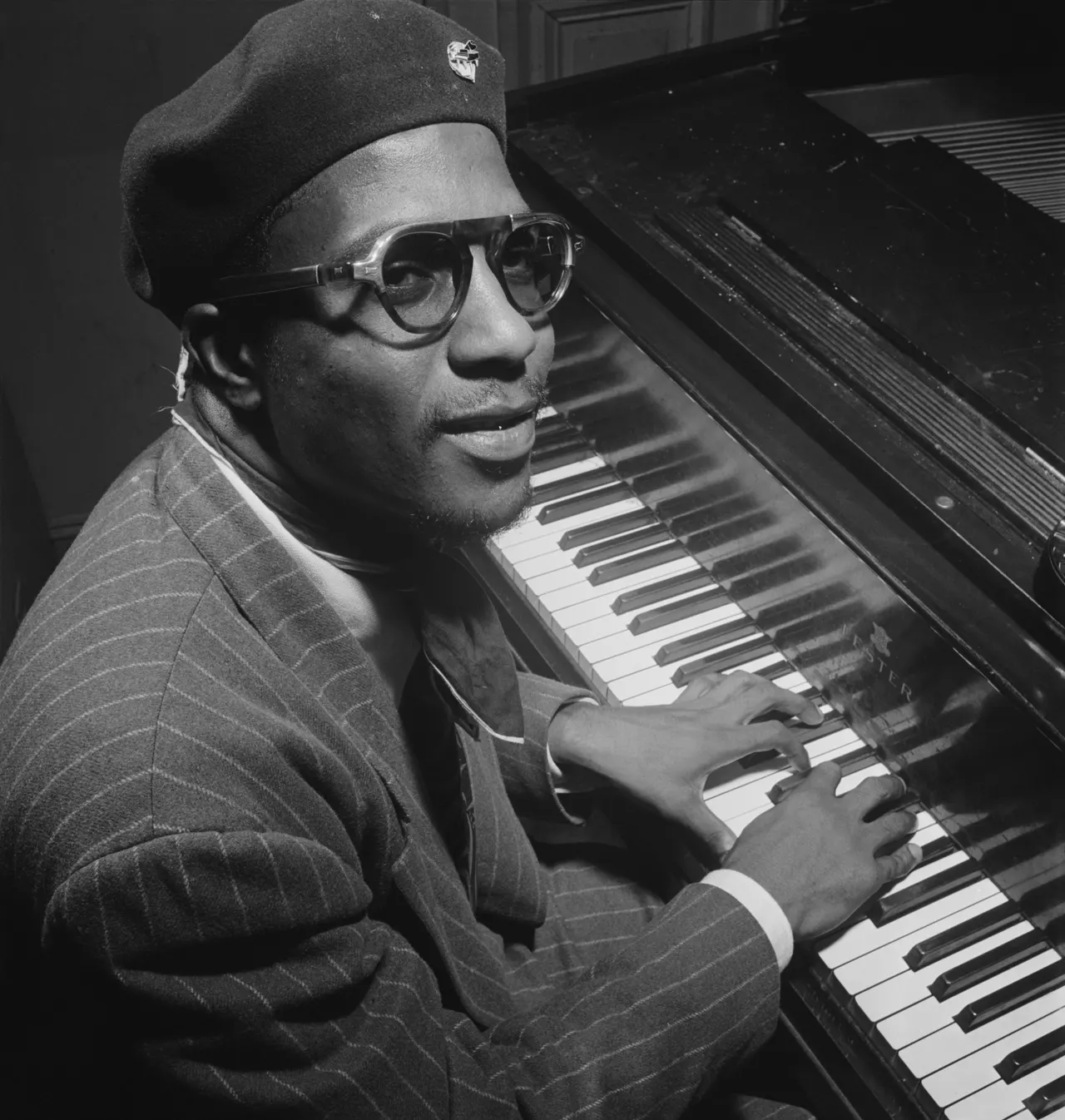
October 10, 1917 (Rocky Mount, North Carolina)February 17, 1982
The persistent lie about Thelonious Monk is that he was a primitive: a great composer who happened to be a clumsy pianist, all elbows and wrong notes, saved by the strength of the tunes. You still hear it. It survives because the alternative takes work, and the alternative is this: Monk had a harmonic system of unusual rigour, applied it consistently for forty years, and the parts that sound like accidents are the parts he was most careful about.
You can identify him in two notes. That is not a compliment people can pay to many pianists, and it is not an accident either. It is what happens when somebody decides, early and permanently, exactly which dissonances belong to him.
Rocky Mount, San Juan Hill, and a very long wait
Thelonious Sphere Monk was born in Rocky Mount, North Carolina on 10 October 1917 and raised in New York from early childhood. He was substantially self-taught, and his technique — flat fingers, percussive attack, a great deal of the arm — is the technique of somebody who worked out what he wanted the piano to do before anyone told him how it was normally done.
By the early 1940s he was house pianist at Minton’s Playhouse in Harlem, in the room where bebop was being assembled, alongside Kenny Clarke, Charlie Parker and Dizzy Gillespie. He lost the Minton’s job in 1943, which is a detail worth sitting with: the man at the centre of the founding myth of modern jazz was let go from the job the myth is set in.
His first recordings came in 1944, as Coleman Hawkins’s pianist. Some of Hawkins’s own fans complained about the eccentric pianist; the veteran tenor kept him anyway, which tells you something about both of them.
Then he waited. The tunes existed; almost nobody was playing them.
1947, and a catalogue arriving all at once
Alfred Lion signed him to Blue Note, and across three sessions in the autumn of 1947 — 15 October, 24 October and 21 November, all at WOR Studios — Monk recorded a body of composition that most writers spend a career failing to match: “Thelonious”, “Ruby, My Dear”, “Well, You Needn’t”, “Off Minor”, “In Walked Bud”, “Monk’s Mood” and “’Round Midnight”.
That is not a promising debut. That is a canon, delivered in five weeks, by a thirty-year-old whose main professional distinction to that point was being thought difficult.
“’Round Midnight” is the outlier even here. Monk had copyrighted it in 1943, and Cootie Williams’s orchestra recorded it before he did. So the tune the world knows him for was a standard before its composer ever put it on tape.
What is actually happening in the hands
Here is where the primitive story falls apart, because Monk’s dissonance is not approximate. It is generated.
The whole-tone scale is a chord written sideways. This is the single most useful thing to understand about him, and it is checkable rather than atmospheric. Take the whole-tone scale from C: C, D, E, F sharp, G sharp, A sharp. Now build a dominant ninth on C with both a flattened and a raised fifth — C, E, G flat, G sharp, B flat, D. Those are the same six pitches. The scale and the chord are one object. Which means every one of the six notes in that collection can be the root of the same sonority, and the collection contains six of them: C, D, E, G flat, A flat and B flat.
There are only two whole-tone collections. The other one holds D flat, E flat, F, G, A and B. And here is the part that turns a curiosity into a technique: any two roots a fourth apart sit in opposite collections. So on a cycle of dominants — D7 to G7 to C7 to F7, the bridge of rhythm changes — you simply alternate the two scales, and each one automatically spells the altered ninth chord you are sitting on. One binary choice, and the harmony is correct all the way round the circle.
That is why the habit is not a mannerism. The scale is the melodic shadow of a chord he was already hearing, which is also why it turns up in his written themes and not only in his solos: the third and fourth bars of “Four in One” run straight up a whole-tone scale over a dominant chord.
So why does everybody else sound bad doing it? Because the scale is symmetrical, and symmetry is boring. Run it evenly and it sounds like an exercise. Monk’s whole-tone runs stagger. They hesitate, rush, start late, land early, and stumble deliberately — and you can tell it is deliberate, because the note he wants arrives on the beat he wants it on. The scale supplies the pitches. The rhythm supplies the meaning. Anyone who copies the first and not the second sounds like a wrong-note machine, which is precisely what the critics thought they were hearing.
Three things worth stealing, in ascending order of difficulty:
- Learn both whole-tone collections cold, as chords rather than scales. Not six-note runs. Learn the collection as every altered-fifth ninth chord on its own six roots at once. Then a cycle of dominants needs one decision per chord instead of six.
- Play a melody and remove a third of it. Monk’s own written advice to his band, in a list generally credited to Steve Lacy around 1960, includes the instruction: “Don’t play everything (or every time); let some things go by. Some music just imagined. What you don’t play can be more important than what you do.” Take a solo you already play and delete notes until it hurts.
- Displace before you decorate. Take a phrase you can play cleanly and put it in the wrong place in the bar, on purpose, then make it land right anyway. That is the actual difficulty, and it is a rhythmic skill rather than a harmonic one.
On the minor second. The interval most associated with him is the crushed half step, and the mistake is to treat it as spice sprinkled on top. In his own tunes the semitone is structural: the harmony rises chromatically inside the voicing, and the tension between a major and a minor seventh, or a third and an eleventh sounding together, is where the chord actually lives. Voice it as an accident and it sounds like one.
On space, which is the hardest of all. Every account of Monk mentions the silences, and almost none of them explain what the silences are for. They are not pauses for effect. A Monk phrase leaves a hole where a lesser player would put a filler lick, and the hole does two things: it makes the next attack land like an event, and it hands the bar to the drummer. That is a bandleader’s choice as much as a pianist’s, and it is the reason his groups swing harder than their tempos suggest.
The bandleader nobody writes about
There is a document that ought to be better known than it is. In 1960 the saxophonist Steve Lacy, then working with him, wrote down the things Monk said to his band. It is a page of instructions, and it is the clearest window anyone has into how he actually thought about music with other people in the room.
Almost none of it is about harmony. It is about time, responsibility and restraint:
Just because you’re not a drummer, doesn’t mean that you don’t have to keep time.
Make the drummer sound good.
The inside of the tune (the bridge) is the part that makes the outside sound good.
That third one is a composer’s sentence disguised as a rehearsal note, and it is worth a great deal of thought. The bridge is not a break from the tune. The bridge is the thing that makes the A sections mean what they mean, which is exactly how his own bridges function and exactly what most players get wrong when they treat the middle eight as somewhere to park.
And then, on how to accompany:
Don’t play the piano part, I am playing that. Don’t listen to me, I am supposed to be accompanying you!
Read those two sentences together and the famous eccentricity resolves into something much more ordinary and much more demanding: a leader telling a soloist not to lean on him. The reason Monk’s comping sounds so sparse and so strange is that it is not there to hold anyone up.
He also, notoriously, got up from the piano and danced in a slow circle while his sidemen soloed. Every profile files this under eccentricity. Put it next to the advice above and a duller, better explanation appears: a man who has just told his band to keep their own time, physically removing himself so they have to.
Six years without a card
In August 1951 Monk was in a car with Bud Powell when narcotics were found. He was arrested, and the New York police revoked his cabaret card — the licence without which a musician could not work anywhere in the city that served alcohol. He did not get it back until 1957.
The story everyone tells is that he took the rap for Powell and refused to testify against his friend. The story everyone tells may be wrong: the scholar Lewis Porter has argued at length, against the received account, that Monk did not take the rap. What is not in dispute is the consequence, and it is worth stating precisely rather than dramatically. He was not silenced. Enforcement fell hardest on Manhattan nightclub engagements running more than a couple of nights, which is exactly the work that pays and builds a career, so for six years he was shut out of it. What he did instead was play neighbourhood rooms in Brooklyn, the Bronx and Harlem — including a five-month run of weekends at a Brooklyn club called Tony’s — take work out of town, give concerts including at Town Hall, record in Paris, and appear on national television. Not silence. Just six years of the wrong rooms.
The card came back in 1957 and he walked straight into the residency at the Five Spot Café with John Coltrane on tenor, Wilbur Ware and then Ahmed Abdul-Malik on bass and Shadow Wilson on drums. It began in July and ran close to six months.
The timing is almost too neat. Coltrane had just been dismissed from Miles Davis’s band over his addiction, had cleaned up in Philadelphia, and arrived at the Five Spot with everything to prove. Monk had spent six years locked out of the rooms that mattered in his own city. Two men at the bottom of their respective years, in a small room on the Bowery, for half a year. Writing in Down Beat in 1960, Coltrane put it like this:
Working with Monk brought me close to a musical architect of the highest order. I felt I learned from him in every way; through the senses, theoretically, technically.
Coltrane was not a man who handed out that sentence casually, and the word to notice is architect. Not colourist, not stylist. Architect.
The cabaret card system was finally abolished in 1967, ten years too late to do Monk any good.
The good years, and then the silence
Riverside had signed him in 1955, and the run that follows is the one most listeners start with: Brilliant Corners, recorded in 1956 and issued the following year, whose title track was so hard that the released version had to be assembled from takes, with Sonny Rollins on tenor and Max Roach on drums. Monk’s Music. The solo records.
In 1962 he signed to Columbia, one of the largest labels in the world, and made Monk’s Dream. In February 1964 he appeared on the cover of Time, which almost no jazz musician ever did. His own official biography calls him the third; Louis Armstrong in 1949, Dave Brubeck in 1954 and Duke Ellington in 1956 had all been there before him, so that count only works for Black jazz musicians, and it is better to say so than to repeat a tidy number. He had a settled quartet with Charlie Rouse on tenor, he toured Europe and Japan, and he played Lincoln Center with a big band. For a man barred from the good rooms in his own city seven years earlier, that is a considerable distance travelled.
Then it stopped. He performed less and less through the mid-1970s, gave his last public performances in 1976, and spent his final years in near-total withdrawal at the New Jersey home of the Baroness Pannonica de Koenigswarter, who had been his patron and friend for decades. He died on 17 February 1982.
The reasons are usually given as mental illness, and they are usually given confidently. They should not be. What is documented is the withdrawal itself and its length. Retrospective diagnosis of a man who cannot answer is not history, and a page like this one has no business performing it.
What is documented and what is a story
Three separations worth making, and one of them is a correction to our own app.
“Talking about music is like dancing about architecture” is not a Monk quotation. Our app has carried it as his signature line, and we have now removed it. The saying has no verified origin; it has been attributed at various times to Monk, Elvis Costello, Laurie Anderson, Frank Zappa, Steve Martin, Charles Mingus, Miles Davis and about a dozen others, which is the reliable signature of an orphan quote. The best current research points to the comedian Martin Mull, first attributed in print in 1979, three years after Monk stopped performing, with earlier variants of the construction going back to 1918. Costello, who is blamed for it most often, has explicitly denied saying it.
The line we have put in the app instead is better anyway, and we are labelling its provenance honestly rather than swapping one confident attribution for another: it comes from the page of Monk’s sayings generally credited to the saxophonist Steve Lacy, who was working with him around 1960. That document is widely reproduced and it is not a primary artefact we have inspected. “A note can be small as a pin or as big as the world, it depends on your imagination.”
The Bud Powell story is contested, as above. We say what happened — the arrest, the card, the six years — and we flag the part that is received wisdom rather than established fact.
And the cabaret card was taken more than once. The 1951 arrest is the famous one, but he had already lost the card in 1948 after a marijuana arrest, and lost it again in 1958 after an altercation with Delaware state troopers. The tidy version of the story has one injustice in it. There were three.
The tunes, which are the real body of work
It is worth saying plainly that Monk is one of the two or three most important composers jazz has produced, and that the pianist argument has always been a distraction from it. Around seventy compositions, of which an unusual proportion became permanent repertoire: “Blue Monk”, “Straight, No Chaser”, “Epistrophy”, “Misterioso”, “Bemsha Swing”, “Rhythm-a-Ning”, “Criss Cross”, “Evidence”, “Little Rootie Tootie”, “Ask Me Now”, “Crepuscule with Nellie”, written for his wife.
What makes them hard is not the notes. It is that melody, harmony and voicing are one object in a Monk tune, and you cannot separate them the way you can with a standard. Take the chords off a Gershwin tune and put new ones underneath and you have a legitimate arrangement. Do that to “Well, You Needn’t” and you have destroyed it, because the chromatic movement in the harmony is the tune. This is why so many well-meaning Monk covers sound wrong while hitting every written pitch: the players treated the changes as a backing track for a melody, and in this repertoire the changes are the melody’s other half.
Where to start, honestly
Brilliant Corners, and give the title track the three listens it needs before it resolves from chaos into architecture. Then the 1947 Blue Note sides for the compositions arriving in their original form, played by the man who thought of them. Then Solo Monk, because a solo record removes every excuse and every collaborator, and what is left is unmistakably a complete musical language rather than a set of mannerisms.
And then sit down with both whole-tone collections and a rhythm-changes bridge, and alternate them around the cycle. It will sound stiff, because you will play them evenly. The first difference you will hear between that and Monk is rhythmic, and it is the one worth chasing first. The rest of the distance is touch, register, what he leaves out, and a willingness to pick the harmonically wrong collection on purpose. That part is a longer conversation and a longer life’s work.
Start with these records
- Brilliant Corners 1957
Showcases Monk's compositional genius. The title track is so difficult it took 25 takes! Also features Sonny Rollins. Pure Monk magic. - Monk's Dream 1963
First album for Columbia Records. Includes definitive versions of 'Bright Mississippi' and 'Bolivar Blues.' Great introduction to his quartet sound. - Solo Monk 1965
Just Monk and the piano. Hear his unique touch, timing, and harmonic conception without any distractions. Essential for understanding his voice. - Thelonious Monk with John Coltrane 1961
Two giants together! Hear how Coltrane navigated Monk's unusual changes. This collaboration influenced the direction of modern jazz.
How to listen
- If you are starting out
- Start with 'Round Midnight' - his most famous ballad. Beautiful and accessible. Then 'Straight No Chaser' - bluesy and fun!
- If you can already comp through a standard
- 'Brilliant Corners' full album. Let the unusual harmonies sink in. Listen multiple times - it grows on you!
- If you are transcribing
- Transcribe 'Brilliant Corners' (the composition). Analyze his use of whole-tone scales and chromatic voice leading. Mind-bending!
Sources
Every year cited, every album title set in italics and every quotation on this page matches the app's own record or a claim in the site's fact file that cites at least two sources on different websites. Where sources disagree, the page says so instead of picking the better story.
- Thelonious Monk artist pageBlue Note Records
- The whole tone scaleEthan Hein
- Thelonious Monk's Advice, transcribed by Steve LacyHoward Rees' Jazz Workshops
- Thelonious Monk's First SessionsJazzTimes
- The Cabaret Card and JazzJazzTimes
- The rare sounds of Thelonious Monk and John Coltrane at the Five Spot CafeKNKX Public Radio
- Monk did not take the rap for Bud PowellLewis Porter
- Thelonious MonkNew York Jazz Workshop
- Thelonious Monk, harmonic and stylistic analysisNuno Marinho
- Thelonious Monk's 25 Tips for Musicians (1960)Open Culture
- Quote Origin: Writing About Music is Like Dancing About ArchitectureQuote Investigator
- Spotlight: 'Round MidnightThe Pulitzer Prizes
- BioThelonious Monk official site
- The Complete Blue Note Recordings of Thelonious MonkWikipedia
- Writing about music is like dancing about architectureWikipedia
- Jazz at 100 Hour 28: The Genius of Modern Music, Thelonious Monk on Blue NoteWTJU 91.1 FM

.jpg)