Ask a piano forum for the best jazz piano books and the same names come back: the Real Book, Mark Levine, then Jeremy Siskind, Frank Mantooth and Phil DeGreg. The ranked lists sort them by level, beginner to advanced. Once you can read a chord symbol, a more useful sort is by the skill each book trains, because the book you need is the one that fixes what is missing from your playing.
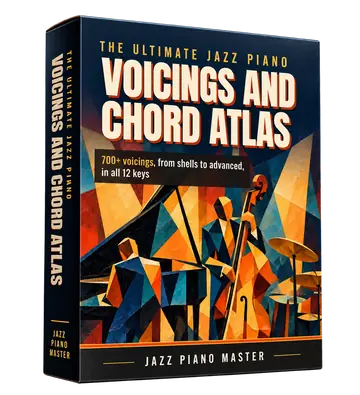
A disclosure first. We wrote one of the twelve books below, The Ultimate Jazz Piano Voicings and Chord Atlas (the Atlas from here on), and we sell it on this site, so weigh its row accordingly. Every description of the other eleven comes from the publisher’s own page, checked against an independent store or library listing on 15 October 2026. Where a pick goes further, it rests on one of three things, and the sentence says which: our own use of the book (we own both of Levine’s and work from them), what learners report on r/JazzPiano, or our own judgment.
What are the best jazz piano books?
For a first course, Jeremy Siskind’s Jazz Piano Fundamentals (Book 1). For theory, Mark Levine’s The Jazz Piano Book and The Jazz Theory Book. For voicings, Phil DeGreg’s Jazz Keyboard Harmony. For comping, Jeb Patton’s An Approach to Comping: The Essentials. For tunes, the Real Book.
The split matters because these are different kinds of book. A course is written to be worked in order, a unit a week. A reference is written to be opened at the chapter you need this month. Reddit has a steady supply of threads from beginners working through Levine’s piano book who found it dense, with chapters they could not follow alone. What they describe is a reference read as if it were a course.
The grid: what each book teaches
Each row comes from the publisher’s own description and an independent store or library listing, checked 15 October 2026. The bold words are each book’s main subject. Where the last column says Our view, the starting point is ours, not the publisher’s.
| Book | What it teaches | What you need first |
|---|---|---|
| Hal Leonard Jazz Piano Method Book 1, Davis | A first course: theory, voicings, scales, rhythm, lead sheets and solos, with audio of every example | Our view: reading music; Hal Leonard pitches it to the complete novice |
| Jazz Piano Fundamentals (Book 1), Siskind | A first course: improvising, voicings, comping, bass lines, blues and bossa nova | All major scales, and hands that can play a Bach Invention |
| The Jazz Piano Book, Levine | Voicings and harmony at the piano, plus tritone substitution, block chords and comping | Our view: reading music, and a first course behind you |
| The Jazz Theory Book, Levine | Theory, for any instrument: scales, the blues, rhythm changes, slash chords, reharmonization | Our view: reading music |
| Jazz Keyboard Harmony, DeGreg | Voicings, two to seven voices, plus comping rhythms, bass lines, simple right hand lines, songs and play-alongs | Our view: reading music; written for any musician, with fingerings |
| Jazz Piano Voicing Skills, Haerle | Voicings, as 123 graded skills, each in all 12 keys, over common progressions | Our view: reading music; it opens with simple major and minor block chords |
| Voicings for Jazz Keyboard, Mantooth | Voicings, as a how-to; the publisher lists nothing else | Any keyboard player; our view: chord symbols and a ii-V-I |
| An Approach to Comping: The Essentials, Patton | Comping: over 80 exercises, transcribed comping, play-alongs | Our view: a few voicings and a few tunes |
| Connecting Chords with Linear Harmony, Ligon | Lines: three outlines for improvising and composing | Our view: a ii-V-I you can play in several keys |
| Jazz Exercises, Minuets, Etudes & Pieces for Piano, Peterson | Technique, through exercises, minuets, etudes and pieces | Our view: reading music; pitched to the novice or the classically trained |
| The Real Book, Volume I, Sixth Edition | Tunes: 400 lead sheets in the C edition, with B-flat, E-flat and bass clef editions | Our view: knowing what to do with a chord symbol |
| The Atlas (ours) | Voicings in every key: seven levels over the ii-V-I, theory in plain words, four fingered line patterns, a blues in each key, a daily plan | A major scale and a chord symbol such as Dm7 |
A short entry in the middle column means only that the publisher’s page lists little, and a single phrase there can hide a whole chapter. Our row is graded from the whole book and every other row from its publisher’s page, which flatters ours, so read the last row with that in mind.
Which jazz piano book is best for beginners?
For a beginner who already reads and plays classical piano, Jeremy Siskind’s Jazz Piano Fundamentals (Book 1). For one new to jazz, with basic piano reading, Mark Davis’s Hal Leonard Jazz Piano Method Book 1, which its publisher writes for the complete novice.
Siskind states his level plainly: the book is for pianists who know all their major scales and have the coordination for a Chopin Nocturne or a Bach Invention. Its twelve units cover the first six months of study, each with lessons, listening and a practice plan, and the course is built to sit beside the Real Book.
If your hands are not at that level yet, Davis’s method asks for less. Hal Leonard presents it as a first jazz course for anyone from the novice up, moving through theory, chords and voicings, scales and modes, rhythm, reading a lead sheet and playing a solo. Work through it first and Siskind’s course makes a natural second book.
Our own free start is the Complete Beginner Path in our app, Jazz Piano Master: four courses written for complete beginners and for classical pianists coming to jazz, and all four are free.
Levine’s The Jazz Piano Book is the other name every beginner hears, and Sher Music sells it as a method. Its chapters run from intervals and triads through voicings, tritone substitution, block chords and comping. Our view, from working with it: make it your second or third book, and open it at the chapter that matches what you are stuck on this month.
If you come from classical piano, Jazz Exercises, Minuets, Etudes & Pieces for Piano, by Oscar Peterson, uses the reading you already have: written-out pieces that its publisher says are meant to give a novice or a classically trained student the technique jazz needs. That page says nothing about playing from a chord symbol, so pair it with a course.
What is the best jazz piano theory book?
Mark Levine’s The Jazz Theory Book, our pick from working with it, if you want one reference that goes deep. Sher Music presents it as a theory book for all musicians, from chord construction and the ii-V-I through scales, the blues, rhythm changes, slash chords, lead sheets and reharmonization.
Beside his piano book, the difference is where the notes live. The piano book puts them under your hands, and the theory book explains why they work on any instrument.
A Reddit thread puts the usual problem plainly: someone working through the theory book and playing no better for it. The cure is to take each chapter to the keyboard the same day: play the idea in three keys, then find it in a tune you know.
What is the best jazz piano voicing book?
Phil DeGreg’s Jazz Keyboard Harmony, for most players. It builds from two-voice shells to seven-voice chords that use fourths or an upper-structure triad, one chapter at a time, and each chapter writes its core progressions out in every key with fingerings. Dan Haerle and Frank Mantooth are close alternatives.
That pick is our judgment from the publishers’ pages, and r/JazzPiano is split on it. Players there name DeGreg and Mantooth as the two standard voicing books; one regular finds DeGreg the easier read, another prefers Mantooth and finds DeGreg overwhelming. The three differ in shape more than in subject. DeGreg follows each chapter with songs arranged for both hands, so a voicing goes straight into a tune, and adds play-along tracks. Haerle’s Jazz Piano Voicing Skills is a graded course of 123 skills, each one in all 12 keys, climbing from simple major and minor block chords to polychords and substitutions. Mantooth’s publisher calls Voicings for Jazz Keyboard more of a how-to book than a textbook, which in our view suits a player who already has the theory and wants shapes.
Two shapes come up in most voicing methods. Rootless voicings spells out the A and B forms a pianist’s left hand trades between, and drop 2 voicings shows how moving one note down an octave turns a close chord into a two-handed one. Read those two first and the opening chapters of any voicing book will be familiar.
The test of a voicing book comes a month after you finish a chapter. Can you find the rootless ii chord of E-flat, an Fm9, without working it out? If you cannot, go back to that chapter and take it through more keys.
Is there a book that tells you exactly what to drill?
Yes, though few are built that way. Haerle’s course goes skill by skill through every key. The Atlas, ours, is built around exactly that: seven levels of voicings over the major and minor ii-V-I, each printed in all 12 keys, in a fixed order with a daily plan.
The levels run two-hand shells, rootless A, rootless B, drop 2, drop 3, two-hand block and quartal. Level 1 in C voices the Dm7 as D3 and C4 in the left hand, F4 and E5 in the right, and every level is laid out that way in each key, with a tracker for ticking off each key as it comes back to your hands. A 30-day plan names a key, a level and a line pattern for each day, with a review every sixth day, then a 12-week schedule takes over, at fifteen minutes a day. The foundations, in plain words, and twenty rules of voicing explain why each shape works.
It is not a comping method: it gives you the shapes but none of the rhythms you play behind a soloist, so for that you still want Patton. It teaches no tunes beyond a blues page in each key, and Levine goes much deeper on theory. Add it beside a method once you know what a voicing is and need it in every key. If that is your gap, the Atlas is here.
To try the approach first, our free Jazz Voicing Cheat Sheet, sent by email from the form at the foot of this page, has shells in C and the two rootless voicings in all 12 keys, ten pages in all.
Which book teaches comping?
Jeb Patton’s An Approach to Comping: The Essentials, from Sher Music. It is the only book here written entirely about playing behind a soloist: basic rhythms and voicings first, then over 80 comping exercises, with downloadable demonstrations and play-along tracks.
Its spine is transcription. Eleven of its examples transcribe, note for note, Tadd Dameron, Barry Harris, Bud Powell and Horace Silver comping behind soloists, and Patton adds interviews on comping with Harold Mabern and Renee Rosnes. In our experience comping is learned from records more than from rules, so a book built on records suits it.
Siskind and DeGreg each give comping a section, and Levine a chapter. If comping is the weak spot, the thing a bandleader mentions after the gig, Patton is our pick.
What is the best jazz piano improvisation book?
For lines that move through the changes instead of running up and down a scale, Bert Ligon’s Connecting Chords with Linear Harmony. By Hal Leonard’s account it distils three basic outlines that improvisers and composers use, drawn from hundreds of examples by great jazz players.
In our view the useful idea is in the title: a line that leads from one chord into the next. Work one outline at a time over a ii-V-I in a few keys before you take it into a tune. Siskind teaches improvising as part of his course, Levine’s theory book carries the scales if you want the raw material, and the Atlas has four line patterns over the same ii-V-I its voicings drill.
Do you need the Real Book?
Yes, or something like it, because a method teaches the language and tunes are where you use it. Hal Leonard’s The Real Book, Volume I, Sixth Edition holds 400 songs as lead sheets in its C edition, and the series also comes in B-flat, E-flat and bass clef editions.
A lead sheet gives you the melody and the chord symbols and nothing else, so the book only becomes useful once a method has shown you what to do with a symbol like Dm7. Start with the tunes on records you love; our fifty essential albums are a good place to find them.
Our first shelf for each kind of player
Beginner, new to jazz, with basic piano reading. Davis’s method, then Siskind’s course once your hands catch up.
Beginner with classical lessons behind you. Siskind’s course and the Real Book, with Peterson’s etudes for the hands. In the second year, open Levine’s piano book as a reference.
Intermediate: you play tunes, but your chords sound thin. One voicing book: DeGreg if you want songs after every chapter, Haerle if you want a graded checklist, the Atlas if you want a fixed daily drill in every key. Pick one: by their own descriptions, all three take voicings through common progressions in every key.
Further along: your voicings are fine, but your comping is stiff and your lines wander. Patton for the comping and Ligon for the lines, with the records of the pianists Patton transcribes playing while you work.
Of the nine pianists on our page about how the masters practised, four had a formative person close by who was not a schoolteacher, Peterson’s father and sister and Tyner’s neighbour among them. Whichever shelf you choose, play what you learn each week to a teacher or a friend who plays.
Questions people actually ask
- What is the best book about jazz?
- If you mean a book about the music rather than a method, two are worth naming. The History of Jazz, by Ted Gioia, now in a third edition from Oxford University Press, tells the story from its beginnings to players working today. Thinking in Jazz, by Paul Berliner, from the University of Chicago Press, shows how jazz musicians learn to improvise, drawing on interviews with more than fifty professionals, the pianists Tommy Flanagan and Barry Harris among them.
- What is the most effective way to learn jazz piano?
- One method book worked in order, a handful of tunes learned from lead sheets, and daily listening to the pianists you want to sound like. A teacher speeds all three up, because a book cannot hear your time or your touch. Without one, record yourself once a week and play it back beside the record you are copying.
- Is jazz the hardest genre to play on piano?
- It is hard in a different place. A classical pianist is handed every note, while a jazz pianist is handed a chord symbol and has to supply the notes on the spot, in whatever key the tune is in. That is why several voicing books, ours among them, drill every key: the skill they train is finding a chord without reading it.
- Is Voicings for Jazz Keyboard by Frank Mantooth good as a first book?
- In our view, only once you can read chord symbols and know what a ii-V-I is, because its publisher pitches it as practical rather than theoretical. The starter book list on r/JazzPiano puts it after the first year of study, beside Jazz Keyboard Harmony by Phil DeGreg, and players there are split on which of the two reads more easily. DeGreg builds up from two-voice shells, so it is our pick if you own neither, with Mantooth as a second view of the same ground.
- Are there technique books for jazz chords, scales and arpeggios?
- A few, and most of them mix technique with harmony. Peterson's book trains the hands through written pieces. DeGreg gives fingerings for each chapter's core progressions, so even a non-pianist can play them. The Atlas, which we make, prints lines and arpeggios over the ii-V-I for both hands with every line fingered, beside the voicings it drills.